What to Check Before Enrolling in an Advanced Yoga Teacher Training Programme
An advanced yoga teacher training programme should take your existing knowledge further. Before enrolling, check whether the course matches your previous training, what new subjects it covers and how much opportunity you will have to apply what you learn.
A 300-hour yoga teacher training programme is not simply a longer version of a beginner course. It should offer a meaningful next stage of study, with opportunities to develop your practice, understand yoga in greater depth and refine your teaching approach.
If you are considering a 300-hour yoga teacher training in Goa, take time to review the curriculum, faculty, practical teaching sessions, certification and residential arrangements. These details will help you decide whether the programme is appropriate for your goals.
Is an Advanced Yoga Teacher Training Programme Right for You?
Start by considering what you want from the next stage of your yoga education.
Some students have completed foundational teacher training and want to become more confident instructors. Others already teach classes and want to explore different yoga styles, deepen their understanding of anatomy or study philosophy and meditation in greater detail.
An advanced programme may be worth considering if you want to:
- Develop a more structured personal practice.
- Understand alignment and modifications in greater depth.
- Improve your class planning and sequencing.
- Explore additional yoga traditions and practices.
- Develop your understanding of pranayama and meditation.
- Refine how you demonstrate, explain and guide postures.
- Continue studying yoga philosophy and anatomy.
Be realistic about your current experience. A longer course does not automatically make it the right next step. Your previous training and learning objectives should guide the decision.
- Check the Eligibility Requirements
Before applying, ask the school what previous training it expects.
Many advanced teacher training pathways are designed for students who have completed foundational yoga education. However, entry requirements differ between schools and programmes. Some may require a completed 200-hour teacher training certificate, while others may consider equivalent experience or additional criteria.
Bhakti Yogshala describes its Goa 300-hour programme as intermediate to advanced and intended for people with an existing foundation in yoga.
Before enrolling, confirm:
- Whether a previous 200-hour certificate is required.
- Which certificates or equivalent experience the school accepts.
- Whether previous teaching experience is expected.
- Whether there is an application or eligibility review.
- Whether the course is suitable for your current practice level.
If you are unsure whether your background is sufficient, send the school details of your previous training and ask for confirmation before making a payment.
- Look for Progression in the Curriculum
The curriculum is one of the most important parts of an advanced yoga teacher training programme.
Do not judge a course only by the number of yoga styles listed on its website. Ask what you will actually study within each subject and how the learning builds on your existing knowledge.
Advanced asana and alignment
Look for opportunities to study posture alignment, transitions, modifications, props and the principles behind different asana practices.
A useful programme should help you understand how to explain a posture, observe its execution and offer appropriate guidance within your training and teaching scope.
Anatomy and movement
Anatomy becomes particularly relevant when you begin to examine how different bodies move and respond to yoga practice.
Check whether the curriculum includes the skeletal and muscular systems, movement, breathing and the relationship between physical practice and body awareness.
Ask how anatomical concepts are connected to practical sessions rather than taught only as theory.
Pranayama and meditation
An advanced programme may introduce additional breathing practices, meditation methods and a deeper understanding of their place within yoga.
Ask which techniques are taught, how they are introduced and whether the course includes guidance on appropriate practice.
Yoga philosophy and traditional study
Yoga education extends beyond physical postures. Review whether the course includes philosophical study, traditional texts, ethics, lifestyle and the wider principles of yoga.
Bhakti Yogshala’s published 300-hour curriculum includes Hatha, Ashtanga Vinyasa, Vinyasa and Yin Yoga, along with pranayama, meditation, yoga philosophy, anatomy, chanting and teaching methodology.
Request the detailed syllabus and check how the school divides the available training hours between these subjects.
- Understand the Teaching Practice and Assessment
If you intend to teach after completing the programme, find out how the school prepares students to lead classes.
Performing a posture and teaching it are different skills. A teacher must be able to communicate instructions, demonstrate movements, observe students and organise a class.
Check whether the programme includes:
- Practice teaching in front of peers.
- Demonstration and verbal instructions.
- Class planning and sequencing.
- Alignment and adjustment principles.
- Observation and assisting.
- Feedback from instructors.
- Written or practical assessment.
Ask how many teaching sessions you will lead and whether instructors observe your performance. Find out how feedback is delivered and whether you have opportunities to apply it in later sessions.
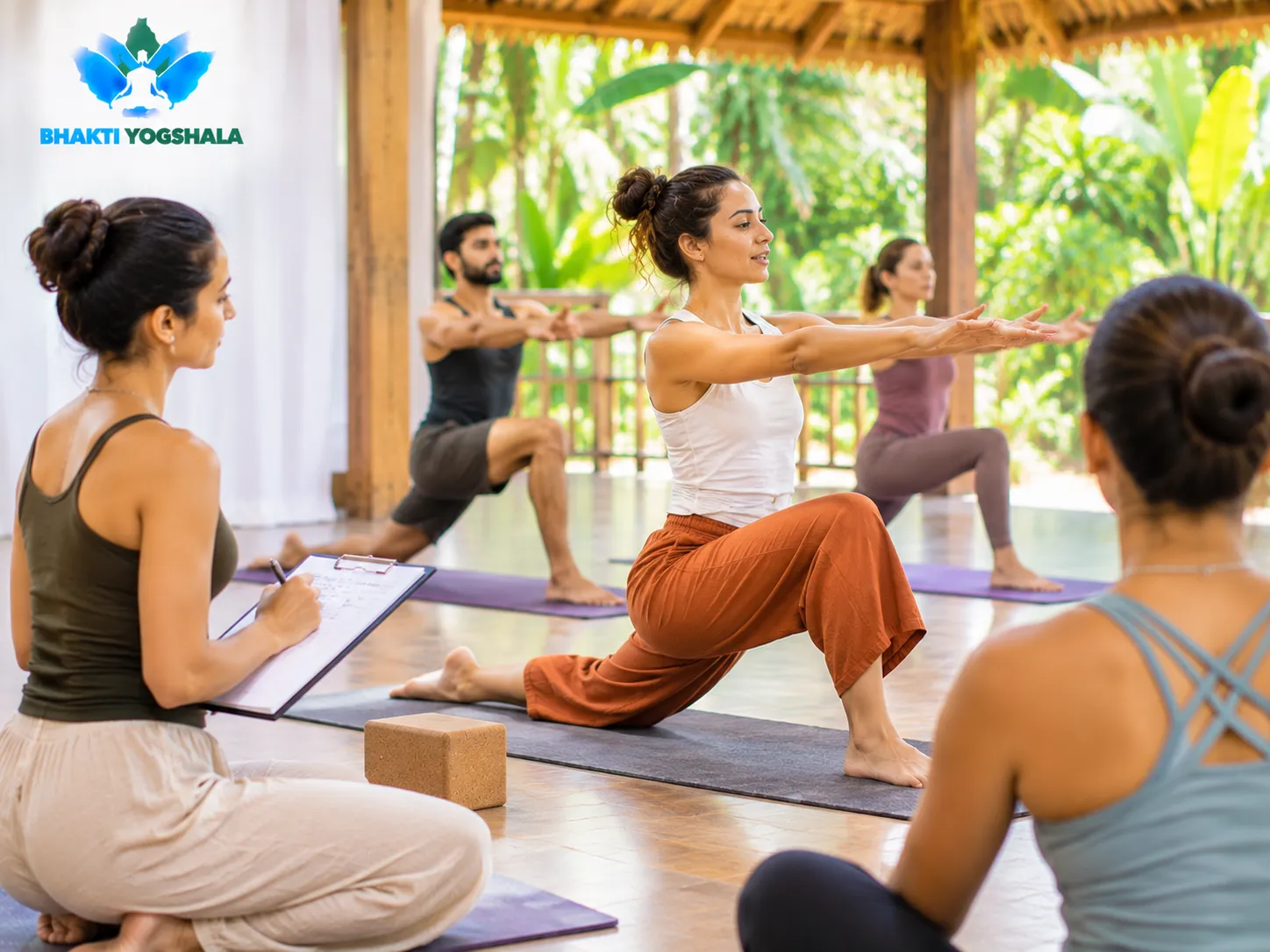
Bhakti Yogshala’s published course information describes students taking turns practising their teaching skills in front of peers and teachers. It lists demonstration, alignment and instructions as part of the practice. Its teaching methodology section also includes communication, observation, assisting, correcting, use of voice and class planning.
The course page lists written tests, oral tests, attendance, performance and behaviour among its assessment factors. Ask the school how these requirements are applied during your selected batch.
Check the practicum hours
If a school advertises a Yoga Alliance RYS 300 programme, review the relevant standards rather than relying only on the phrase “international certification”.
Yoga Alliance’s published RYS 300 standards include a 30-hour practicum category. They specify minimum contact-hour requirements and require at least five contact hours of active practice teaching as the lead instructor.
These are standards for the relevant Yoga Alliance credential. They should not be assumed to describe every school’s actual schedule without checking its current registration and approved curriculum.
- Check Who Will Teach Your Batch
The teaching team has a direct influence on the subjects you study and the way they are explained.
A school may have several instructors, each with a different area of specialisation. One teacher might lead Hatha or Ashtanga Vinyasa sessions, while another handles philosophy, pranayama, anatomy or meditation.
Review the teacher profiles and look for:
- Relevant yoga education and qualifications.
- Teaching background.
- Subject specialisation.
- Experience with advanced students.
- Experience conducting teacher training.
- The subjects each instructor is expected to teach.
There is another question worth asking: who will actually teach your selected batch?
A teacher appearing on a school’s website may not necessarily be assigned to every course date. Ask for confirmation of the lead trainer and subject instructors before enrolling.
Bhakti Yogshala publishes a separate teacher-profile page. Prospective students can review the available profiles and contact the school to confirm the faculty allocation for their preferred 300-hour batch.
- Verify the Certification and Registration
Certification matters if you intend to use your training as part of a professional teaching pathway.
However, a certificate and a school’s registration are not automatically the same thing. Understand which organisation issues the credential and what the registration represents.
Before paying, ask:
- Which organisation is associated with the course?
- What is the exact certificate issued after completion?
- Is the school’s relevant registration currently active?
- Does the registration cover the 300-hour programme?
- What attendance and assessment requirements must be completed?
- Can the details be checked through the organisation’s official website?
If Yoga Alliance registration is important to your plans, use its official resources to verify the school’s current status and relevant credential.
Also consider where you intend to teach. Course completion or school registration does not automatically guarantee employment or permission to teach in every country. Local requirements may differ.
- Understand the Course Duration and Daily Schedule
Advanced training can involve several hours of practice and study each day. Check the complete timetable before deciding whether you can commit to the programme.
Bhakti Yogshala describes its 300-hour Goa programme as a 28-day training course. Its published schedule includes:
- Morning self-practice, warm-up, pranayama or meditation.
- Hatha, Vinyasa, Ashtanga or Yin asana sessions.
- Yoga philosophy and theory.
- An asana clinic, adjustment and practicum period.
- Anatomy and further theory.
- Evening meditation, kirtan or group discussion.
This gives prospective students an overview of the daily learning structure. Confirm the timetable for your selected batch, including any changes to class timings or course arrangements.
Also ask how the school calculates the total training hours. Request a written breakdown showing the hours allocated to practical classes, theory, supervised teaching, assessment and independent study.
- Check Accommodation, Meals and Location
If the programme is residential, the living arrangements will be part of your training experience.
Before booking, confirm:
- Whether accommodation is included.
- Available room categories.
- Whether meals are provided.
- Dietary options.
- Wi-Fi and other essential facilities.
- Laundry and drinking-water arrangements.
- Check-in and check-out dates.
- Any additional charges.
Ask for current photographs of the actual accommodation and practice spaces if these details are important to your decision.
Bhakti Yogshala lists its Goa training location on Main Agonda Beach Road, Canacona, Agonda, Goa 403702. Its 300-hour course page also describes accommodation and vegetarian meals among the programme inclusions.
Confirm the current arrangements directly with the school. Do not assume that inclusions or room options remain identical across every batch.
- Calculate the Complete Course Cost
The advertised tuition fee may not represent the full amount you will spend.
Ask for a written fee breakdown covering:
- Course tuition.
- Accommodation.
- Meals.
- Study materials.
- Certification-related charges, where applicable.
- Airport transfers, if offered.
- Taxes and additional charges.
- Payment deadlines.
Read the cancellation, refund and rescheduling policy before paying a deposit. Find out what happens if you cannot attend the selected batch or need to change your travel dates.
Keep written confirmation of the programme, dates, amount paid and agreed inclusions.
If you are comparing several 300-hour yoga teacher training programmes in Goa, compare what each fee actually covers rather than choosing solely on the lowest advertised price.
- Questions to Ask Before Paying a Deposit
Before confirming your place, contact the school and ask for clear answers to the following:
- What previous yoga training do I need?
- Which teachers will conduct my selected batch?
- Can I receive the full course syllabus?
- How are the training hours divided?
- How many supervised teaching sessions are included?
- Will I receive individual feedback?
- How will my performance be assessed?
- What certificate will I receive?
- How can I verify the school’s registration?
- What is included in the course fee?
- What are the accommodation and meal arrangements?
- What is the cancellation and refund policy?
A school should be able to explain its course requirements and booking terms clearly. If an important detail is unclear, ask for written confirmation before making a financial commitment.
- Explore the 300-Hour Yoga Teacher Training at Bhakti Yogshala
Bhakti Yogshala offers a published 300-hour yoga teacher training programme in Agonda, South Goa.
The course page describes a 28-day intermediate-to-advanced programme covering Hatha, Ashtanga Vinyasa, Vinyasa and Yin Yoga, along with pranayama, meditation, anatomy, yoga philosophy and teaching methodology.
The school also publishes information about its daily timetable, teaching practice, assessment and faculty.
If you are considering the programme, review the course details and contact the team to confirm the current batch dates, eligibility, faculty, teaching-practice arrangements, fees and accommodation.
Explore the programme:
https://bhaktiyogshala.com/300-hour-yoga-teacher-training-goa/
Contact Bhakti Yogshala
Address: Main Agonda Beach Road, Canacona, Agonda, Goa 403702
Phone: +91 9897355995
Email: bhaktiyogshala@gmail.com
Choose an advanced programme after checking its actual curriculum and requirements. The right course should match your previous training and give you a clear understanding of what you will study, practise and be expected to complete.
FAQS
What should I check before enrolling in an advanced yoga teacher training programme?
Review the eligibility requirements, curriculum, faculty, teaching practice, assessment, certification, course duration, accommodation, fees and cancellation policy. Request the detailed syllabus and written confirmation of important course details before paying.
Do I need to complete a 200-hour yoga teacher training before joining a 300-hour programme?
Requirements vary by school and credential. Bhakti Yogshala describes its 300-hour course as intermediate to advanced and intended for students with a foundational understanding of yoga. Contact the school to confirm the accepted qualifications for your selected batch.
How do I know whether a 300-hour yoga course is genuinely advanced?
Look for progression beyond foundational study. Review the syllabus for advanced practice, anatomy, teaching methodology, philosophy, practicum and assessment. Ask how the programme builds on your previous training.
What subjects should an advanced yoga teacher training curriculum include?
The subjects depend on the school’s programme and focus. Areas to examine include asana, pranayama, meditation, anatomy and physiology, yoga philosophy, teaching methodology and supervised teaching practice.
How important is teaching practice in a 300-hour yoga teacher training programme?
It is particularly relevant if you intend to teach. Practical sessions allow trainees to work on demonstrations, verbal instructions, class planning and observation. Ask how many sessions you will lead and how instructors assess your teaching.
How can I verify Yoga Alliance certification?
Check the school’s current registration and credential through Yoga Alliance’s official resources. Confirm the exact school name and registration category. Ask the school for the relevant details rather than relying only on a logo or statement on its website.
How long does Bhakti Yogshala’s 300-hour yoga teacher training in Goa take?
Bhakti Yogshala’s published course page describes a 28-day programme. Confirm the current batch dates and timetable directly with the school before arranging travel.
Does Bhakti Yogshala include accommodation and meals?
The published 300-hour course information lists accommodation and vegetarian meals among the programme inclusions. Confirm the available room options, meal arrangements and any additional charges for your selected batch.
What should I ask about course fees before enrolling?
Request a written breakdown of tuition, accommodation, meals, study materials, certification charges and any other costs. Read the deposit, cancellation, refund and rescheduling terms before paying.
Where is Bhakti Yogshala located?
Bhakti Yogshala lists its Goa location as Main Agonda Beach Road, Canacona, Agonda, Goa 403702. Contact the school for current arrival guidance and directions.