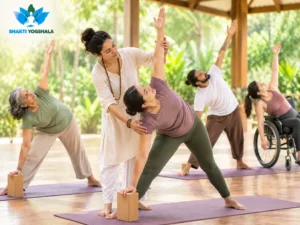
A yoga class rarely contains students with identical bodies, movement patterns or levels of experience. One student may have years of practice but limited shoulder mobility. Another may be new to yoga yet have good balance and strength. Some students may need additional support for standing poses, while others may find seated postures more challenging.
A good yoga teacher recognises these differences and adapts the class without making anyone feel that their body is a problem to be corrected.
Teaching different body types and ability levels involves more than demonstrating several versions of a pose. It requires observation, clear communication, thoughtful sequencing and an understanding of when to offer support. The aim is to help each student practise with awareness rather than expecting everyone to create the same shape.
Why Yoga Teachers Need to Adapt Their Teaching
Two students can follow the same instruction and experience a posture differently. Differences in limb length, joint mobility, balance, strength, previous injuries, confidence and movement experience can all influence how an asana feels.
This is why copying the teacher’s posture should not be the measure of a successful practice.
For example, a student may not be able to bring their hands to the floor in a standing forward fold. Placing the hands on blocks or bending the knees may help them find a more comfortable position. Another student may be able to reach the floor but need to reduce the depth of the fold to avoid discomfort.
Both students are practising the same posture, but the appropriate approach is different.
Teachers who understand adaptation can:
- Offer variations without making students feel singled out.
- Explain the purpose of a pose rather than focusing only on its appearance.
- Recognise when a student needs a simpler option.
- Build classes that accommodate different levels of experience.
- Encourage students to develop body awareness and make informed choices.
The objective is not to make every pose easy. It is to offer an appropriate way for each student to participate.
Understanding Different Bodies Without Making Assumptions
The phrase “different body types” can refer to many things, but a teacher should not decide what a student can or cannot do simply by looking at them.
A person’s appearance does not reliably indicate their strength, flexibility, health, mobility or yoga experience. Teachers should observe how students move, listen to what they communicate and offer choices without attaching labels to their bodies.
1. Body proportions and individual movement
Students have different proportions. The length of their arms, legs and torso can influence how certain postures look and feel.
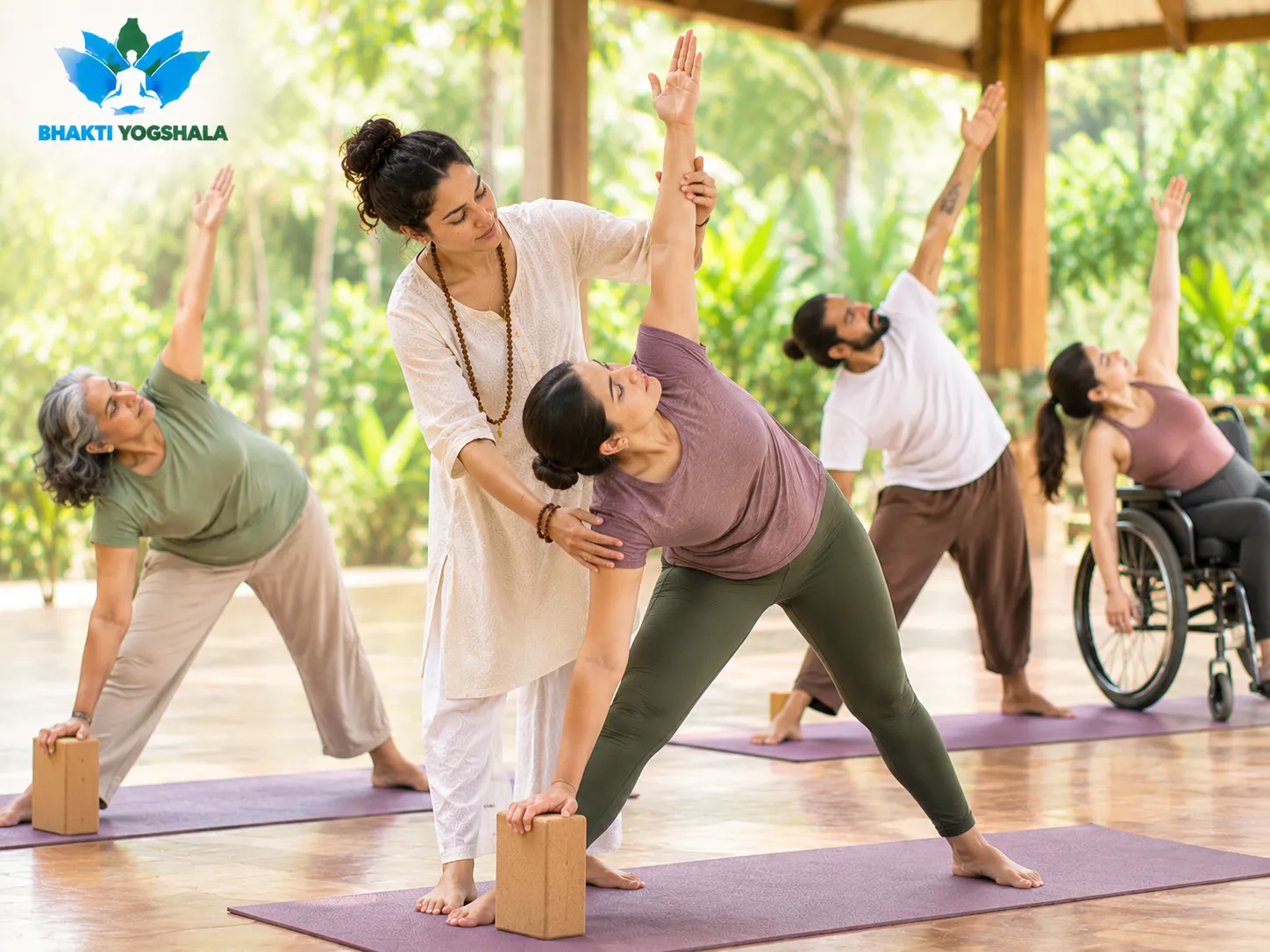
In Trikonasana (Triangle Pose), for instance, one student may comfortably place a hand on the floor, while another may need a block to maintain a stable position. Neither version is automatically better.
Teachers can offer adjustments such as:
- Placing a block beside the front foot.
- Keeping the hand on the shin where comfortable.
- Reducing the distance between the feet.
- Using a wall for additional support.
The teaching point is to help students find a stable position that suits their movement, rather than asking everyone to reach the same depth.
2. Mobility and flexibility
Flexibility varies between individuals and between different areas of the same body. A student may have good hip mobility but limited shoulder movement. Another may find forward folds comfortable but struggle with certain seated positions.
Instead of asking students to push further, teachers can offer options.
For Paschimottanasana (Seated Forward Bend), possible options include:
- Sitting on a folded blanket.
- Bending the knees slightly.
- Using a strap around the feet.
- Keeping the spine comfortably extended rather than pulling the chest towards the legs.
Students should be encouraged to work within a comfortable range and avoid forcing a stretch.
3. Strength, balance and experience
A student who is new to yoga may need time to understand weight distribution, breathing and coordination. An experienced practitioner may be ready to explore more demanding variations, but experience does not mean every advanced posture is appropriate for every person.
For balance poses, teachers can offer a progression:
- Begin with a supported standing position.
- Allow students to keep one hand near a wall or chair.
- Introduce the balancing variation when they feel ready.
- Offer the option to return to the supported version at any time.
These choices help students participate without turning the class into a competition.
How to Modify Yoga Poses for Different Students
A useful modification preserves the intention of a posture while changing the way a student approaches it. The teacher should understand what the pose is intended to develop and then offer an appropriate variation.
The examples below are general teaching options. They are not individual treatment plans or substitutes for advice from a qualified healthcare professional.
1. Standing poses
Standing postures can challenge balance, hip mobility, leg strength and coordination.
For Virabhadrasana II (Warrior II), a teacher might offer:
- A shorter stance for students who need less range.
- A smaller bend in the front knee.
- A chair for support when balance is difficult.
- A comfortable arm position if holding both arms out creates strain.
Watch how students respond rather than assuming that a deeper bend is always the goal.
2. Forward folds
Forward folds can feel different depending on hip mobility, hamstring flexibility and individual proportions.
For Uttanasana (Standing Forward Bend), options may include:
- Bending the knees.
- Placing hands on blocks.
- Resting hands on the thighs or a chair.
- Keeping the torso at a comfortable angle instead of aiming for the floor.
A student should not be encouraged to pull themselves deeper into a fold to match another person’s position.
3. Seated postures
Some students may find floor-based seated positions uncomfortable or difficult to maintain.
For Sukhasana (Easy Pose), teachers can offer:
- A folded blanket or cushion under the hips.
- Support beneath the knees where appropriate.
- A chair-based seated position.
- A different comfortable seated arrangement.
The teacher should make these alternatives available as normal parts of the class, not as special options that draw unnecessary attention.
4. Balancing postures
Balancing postures require coordination and the ability to manage changes in body position.
For Vrksasana (Tree Pose), students can choose to:
- Keep the toes of the lifted foot on the floor.
- Place the foot against the inner calf, avoiding pressure on the knee joint.
- Stand beside a wall or chair.
- Keep their hands at the chest instead of raising them overhead.
A supported variation is still a valid way to practise balance.
Teaching a Mixed-Level Yoga Class
A mixed-level class may include beginners, regular practitioners and experienced students. The teacher needs to make the sequence understandable without making it too basic for everyone.
One practical approach is to teach a common starting point and then offer variations.
For example, during a standing sequence:
- Demonstrate or explain the foundational position.
- Give students time to understand the movement.
- Offer a supported or smaller-range option.
- Explain a more challenging variation for students who are ready.
- Remind everyone that changing options during the class is acceptable.
This approach gives students room to make decisions without dividing the room into fixed categories.
Use clear and adaptable instructions
Instead of saying, “Everyone should reach the floor,” try:
“If your hands do not comfortably reach the floor, place them on blocks, your shins or a chair.”
Instead of saying, “Go deeper into the pose,” try:
“Choose a range where you can maintain steady breathing and control.”
The second style of instruction gives students a useful choice. It also avoids suggesting that one body position is the only correct result.
Observe before offering corrections
Teachers should look at how students enter, hold and leave a posture. A student may appear to reach a familiar alignment but may be uncomfortable. Another may use a different position that works well for their body.
Ask before assuming that a student needs to be corrected. If a student reports pain, dizziness or unusual discomfort, encourage them to stop or leave the posture. Do not attempt to diagnose the cause.
Using Yoga Props to Make Practice More Accessible
Props are teaching tools, not signs of weakness or lack of experience. They can help students explore a posture with more support and control.
Prop | How it may be used in class |
Yoga blocks | Bring the floor closer in standing poses and provide hand support. |
Yoga straps | Help students explore a comfortable range in selected stretches. |
Blankets | Provide cushioning or raise the hips in seated postures. |
Bolsters | Support restorative positions and selected relaxation postures. |
Chairs | Provide support for seated practice, balance and selected standing variations. |
Walls | Offer balance support and help students understand positioning. |
Teachers should explain how to use each prop and allow students time to arrange it before beginning the posture.
It is also helpful to make props available to the whole class. When everyone can use them, students are less likely to feel that support is being offered only because they are less capable.
Inclusive Language and Student Consent
The words a teacher uses can influence how students experience a class. Language that compares bodies or ranks postures may create unnecessary pressure.
Avoid expressions such as:
- “This is the easy version.”
- “Try to get your body into the correct shape.”
- “Everyone else can do this.”
- “You should be more flexible by now.”
Consider alternatives:
- “Choose the variation that works for you today.”
- “You can use a block or chair for support.”
- “Stay within a range that feels manageable.”
- “You may rest or change the posture whenever you need to.”
Ask before using physical adjustments
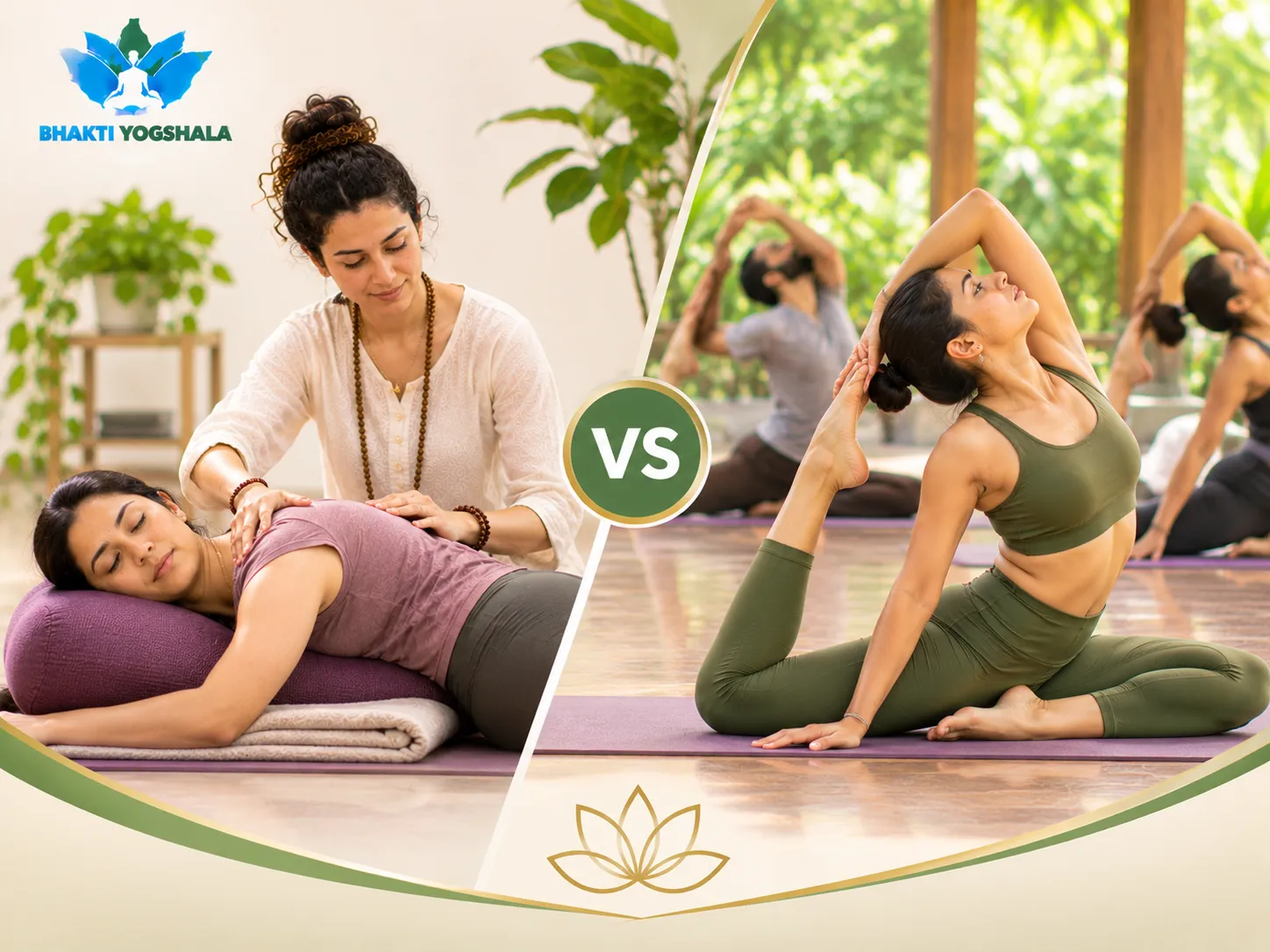
Physical adjustments should never be assumed to be welcome. A teacher should seek clear, informed consent before touching a student and respect a student’s decision to decline.
Verbal guidance, demonstrations and prop suggestions can often help students understand a posture without physical contact.
Teachers should also respect privacy. A student should not have to explain personal health information in front of the class to receive an alternative movement option.
Planning a Class for Different Ability Levels
Inclusive teaching starts before students arrive. A teacher can review the class plan and identify where participants may need choices.
A practical planning process includes:
- Identify the intention of each posture.
Understand what the pose is designed to explore, such as balance, strength, mobility or awareness. - Prepare at least one alternative.
Think about how a student might practise with a smaller range of movement, a prop or additional support. - Check the transitions.
A posture may be manageable on its own, while moving into or out of it may be more challenging. Give students time and explain the transition clearly. - Make the room easier to navigate.
Arrange mats and props so that students can access the support they need without disrupting others. - Leave room for individual choices.
A sequence should not depend on every student completing every posture. Allow time for rest, observation and variation. - Reflect after class.
Consider which instructions were clear, where students needed additional support and whether the sequence offered meaningful choices.
Know the limits of your teaching role
Yoga teachers can provide general instruction, demonstrate variations and help students make choices within the teacher’s training and experience. They should not diagnose injuries, prescribe rehabilitation or promise that a particular modification will treat a medical condition.
If a student describes persistent pain, a recent injury, a medical condition or a concern outside the teacher’s expertise, encourage them to seek advice from an appropriately qualified healthcare professional before continuing with activities that may be unsuitable.
How Advanced Teacher Training Can Develop Your Teaching Skills
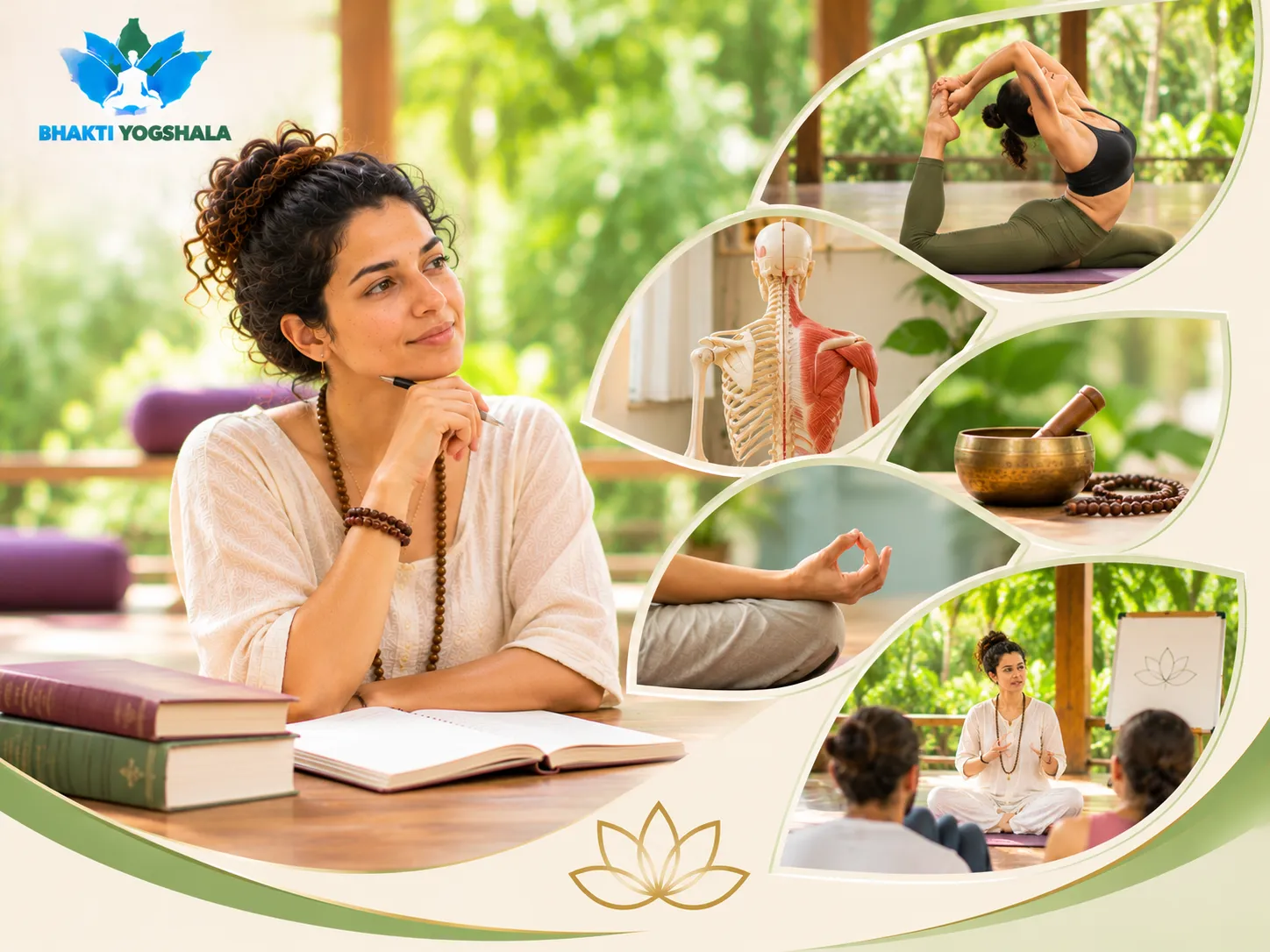
Teaching students with different bodies and ability levels requires more than a personal ability to perform asanas. Teachers need to understand alignment, observe movement, communicate clearly and make considered decisions while a class is in progress.
Further teacher education can help practitioners explore these areas in greater depth.
When comparing an advanced programme, look for learning opportunities related to:
- Asana alignment and adjustments.
- Yoga anatomy and movement awareness.
- Teaching methodology and class planning.
- Observation and demonstration.
- Clear verbal instruction.
- Teaching practice and feedback.
- Yoga philosophy, lifestyle and teaching ethics.
Bhakti Yogshala’s published 300-hour course information describes a programme covering asana practice, adjustment and alignment methodology, yoga anatomy, yoga philosophy, meditation and pranayama. The course page lists 26 hours for adjustment, alignment and methodology. Prospective students should confirm the current syllabus and how these topics are taught before enrolling.
Continue Your Yoga Education at Bhakti Yogshala
Bhakti Yogshala offers a 300-hour yoga teacher training programme in Agonda, Goa. Its published course information describes the programme as an intermediate-to-advanced training for practitioners who already have a foundation in yoga and want to deepen their practice and teaching knowledge.
The listed curriculum includes asana practice, pranayama, meditation, yoga philosophy, anatomy, adjustment, alignment and teaching methodology.
If you are considering advanced yoga education, review the course details and ask the school how the current programme approaches teaching methodology, alignment, modifications and practical teaching feedback.
Explore the 300-hour yoga teacher training in Goa or contact Bhakti Yogshala to ask about the current syllabus, dates, eligibility and course arrangements.
Bhakti Yogshala
Main Agonda Beach Road, Agonda, Goa 403702
Phone: +91 9897355995
Email: bhaktiyogshala@gmail.com
Frequently Asked Questions
How can yoga teachers teach students with different body types?
Start by observing how students move rather than making assumptions based on appearance. Offer variations, props and different ranges of movement. Explain that students can choose the option that feels appropriate for them.
How do you modify yoga poses for beginners?
Use clear instructions and begin with a foundational version of the posture. Offer support through blocks, straps, chairs or walls where suitable. Allow students time to understand the movement before introducing more demanding variations.
Can students with limited flexibility practise yoga?
Limited flexibility does not automatically prevent someone from participating in yoga. Teachers can offer suitable variations and props. Students with pain, injuries or health concerns should seek appropriate professional advice about what practice is suitable for them.
How do you manage different ability levels in one yoga class?
Teach a shared starting position and provide options for different levels of experience. Use clear verbal cues, allow students to change variations and avoid making advanced postures compulsory.
Which props are useful for inclusive yoga teaching?
Blocks, straps, blankets, bolsters, chairs and walls can all support different types of practice. The most appropriate prop depends on the posture, the student’s needs and the teacher’s training.
Should yoga teachers physically adjust every student?
No. Physical adjustments should not be automatic. Teachers should obtain clear consent before touching a student and respect their decision if they do not want an adjustment.
What should I learn to become better at teaching different ability levels?
Useful areas of study include yoga anatomy, alignment, modifications, observation, teaching methodology, class sequencing, communication and teaching ethics. Practical teaching experience and feedback are also important.
Does Bhakti Yogshala offer 300-hour yoga teacher training in Goa?
Bhakti Yogshala lists a 300-hour yoga teacher training programme in Goa. Its published course information includes asana, pranayama, meditation, anatomy, philosophy, alignment and teaching methodology. Contact the school to confirm the current course dates, eligibility, syllabus and availability.