
A 200-hour teacher training introduces the foundations needed to develop a personal yoga practice and begin learning how to teach others.
At Bhakti Yogshala, the course has a Kundalini focus while also covering Hatha Yoga and several supporting areas of yoga education. Students spend time both on the mat and in theory classes.
The curriculum includes:
This means the training is not limited to learning yoga postures. Students also study how a class is structured, how practices are explained and how to work with students during a session.
Hatha Yoga forms part of the physical practice during the course.
Students work with a range of postures and movement patterns, including the Pawanmuktasana series, Surya Namaskar, standing poses, seated poses, forward bends, backbends, spinal rotations, inversions, supine and prone positions, and hand-balancing poses.
The purpose of this practice is to give students a working understanding of asana and how different postures are approached in a yoga class.
The Kundalini part of the training introduces students to traditional practices associated with Kundalini Yoga.
Classes and theory cover areas such as asana, pranayama, mantra, meditation, mudras, bandhas and kriya practices. Students also study the traditional concepts of chakras and nadis.
The course looks at these practices within the wider context of yoga rather than treating Kundalini Yoga as a standalone physical exercise.
Breathwork is part of the regular training schedule.
Students are introduced to pranayama practices including:
These practices are taught as part of the broader yoga curriculum and daily practice.
Meditation is included alongside asana and pranayama throughout the course.
The daily schedule also includes kirtan and group discussion. Mantra practice forms part of the Kundalini-focused curriculum, giving students an opportunity to study practices that extend beyond physical postures.
The training introduces traditional mudras and bandhas and their place within yoga practice.
Topics include Gyan Mudra, Apana Mudra and Kundalini Mudra. Students also study Mula Bandha, Uddiyana Bandha, Jalandhara Bandha and Maha Bandha.
These subjects are covered alongside the physical and theoretical aspects of the course.
Chakras and nadis are part of the traditional framework studied in Kundalini Yoga.
The course introduces the seven major chakras and the three commonly discussed nadis: Ida, Pingala and Sushumna.
Students study these concepts as part of the philosophical and subtle-body aspects of Kundalini Yoga.
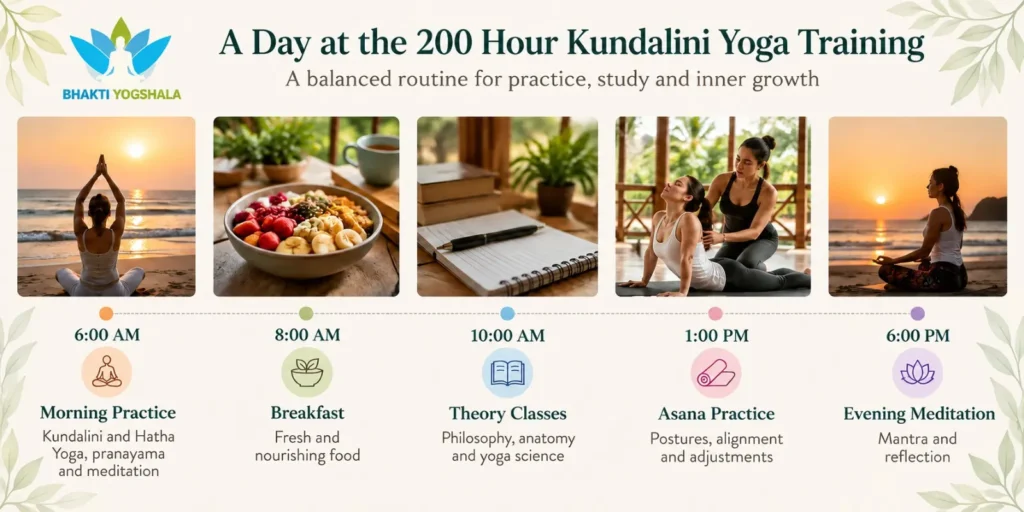
The course follows a structured schedule from early morning through the evening. Students have a mixture of self-practice, classes, theory, meals, rest and group activities.
Time | Activity |
6:30 AM – 7:00 AM | Self-practice, warm-up, pranayama, meditation, jala-neti and posture practice |
7:00 AM – 8:30 AM | Hatha / Kundalini Yoga asana class |
8:30 AM – 10:15 AM | Breakfast and leisure |
10:15 AM – 11:15 AM | Philosophy, theory and Ayurveda |
11:30 AM – 1:15 PM | Asana clinic, adjustment and practicum |
1:30 PM – 3:20 PM | Lunch, rest and leisure |
3:20 PM – 4:20 PM | Anatomy / Theory |
4:30 PM – 6:00 PM | Hatha / Kundalini Yoga asana class |
6:00 PM – 6:30 PM | Refreshment / tea |
6:30 PM – 7:30 PM | Meditation, kirtan and group discussion |
7:30 PM onward | Dinner, study and free time |
The schedule gives students regular time for both practice and study. The exact timetable can change, so students should check the schedule for their intake before travelling.
Practising yoga and teaching a yoga class require different skills. The teacher-training part of the program focuses on helping students understand what happens when they move from being a practitioner to guiding a class.
Teaching methodology covers areas such as:
Students also take part in teaching practicum. This gives them an opportunity to work with the skills they have studied instead of only learning them as theory.
Bhakti Yogshala states that previous yoga experience is not required for this 200-hour course. The program is open to beginners as well as experienced yoga practitioners.
That does not mean the course is casual. Students should expect a full daily schedule with physical practice, theory, study and participation.
If you have a physical condition or another concern that could affect your participation, discuss it with the school before enrolling.
The training is offered as a residential program in Agonda, Goa.
According to the course information, student rooms include natural light, fresh air, shower facilities, Wi-Fi, western toilets, linens and towels. The beach is also described as being within walking distance of the venue.
Living at the school allows students to follow the course schedule without travelling between a separate hotel and the yoga school each day.
Accommodation categories can vary by intake, so it is worth checking which options are available when you apply.
Bhakti Yogshala has an in-house kitchen that prepares vegetarian meals for students.
The published food information includes dishes such as Indian vegetable preparations, khichri, rice, pulses or lentils, fresh fruits and vegetables, herbal tea and Indian masala chai.
Vegan and gluten-free options are also mentioned.
If you have specific dietary requirements, confirm the available arrangements with the school before booking.
The course information also mentions additional therapies provided as complimentary components of the training.
These include:
Course inclusions can change between intakes, so students should confirm the current arrangements before enrolling.
The published course information lists teachers involved in different areas of the training.
Abhishek Negi teaches Ashtanga Vinyasa and Vinyasa Flow. Yogacharya Mahendar Ji covers pranayama, mudra, shatkriya and Ayurveda. Nitin Chotwani teaches Hatha Yoga and pranayama, while Manoj Rawat covers alignment and adjustment. Deepa Ji teaches philosophy and meditation.
Teacher assignments and course faculty can change, so students who want to know who will teach a particular module should confirm the current faculty before registration.
Agonda offers a setting where students can spend their training period away from their normal routine and focus on their studies.
Bhakti Yogshala is located on Main Agonda Beach Road in Agonda, Canacona, Goa. The school describes its training as a residential experience, with the beach within walking distance of the venue.
For international students, studying in Goa can also mean learning alongside people from different countries and backgrounds.
The location is one part of the decision. When comparing yoga teacher training schools, it is also useful to look at the curriculum, teaching staff, daily schedule, accommodation, course inclusions and teaching practice.
Course dates, availability and accommodation prices may vary between intakes.
Bhakti Yogshala publishes different accommodation categories, including triple-sharing, double-occupancy and private-room options for listed course dates.
Since dates and fees can change, check with Bhakti Yogshala for the current intake before making flight or travel arrangements.
Students interested in the 200 Hour Kundalini Yoga Teacher Training can enquire through Bhakti Yogshala’s website and application options.
The application form asks for basic contact information, preferred course dates, phone number and a message.
Before confirming your place, ask the school about:
This can help you plan the trip and understand what is included before you book.
Bhakti Yogshala’s 200-hour Kundalini Yoga Teacher Training combines regular yoga practice with study and teaching preparation.
Students work with Hatha and Kundalini Yoga, pranayama, meditation, mantra, philosophy, anatomy, mudras, bandhas, chakras and teaching methodology. The residential format also includes accommodation and vegetarian meals.
If you are considering a Kundalini Yoga teacher training in Goa, review the course curriculum and daily schedule first. Then contact Bhakti Yogshala to confirm the next available intake, fees, accommodation and current course inclusions.
Main, Agonda Beach Road
Agonda, Canacona, Goa 403702, India
Phone: +91 9897355995
Email: bhaktiyogshala@gmail.com
No. Bhakti Yogshala states that previous yoga experience is not required. The course is open to beginners as well as experienced practitioners.
The curriculum includes Hatha and Kundalini Yoga, pranayama, meditation, mantra, philosophy, anatomy, teaching methodology, mudras, bandhas, chakras and related yoga practices.
It is a 200-hour teacher training program with daily sessions running from morning through evening. The exact duration and dates should be confirmed for the intake you plan to attend.
The school offers yoga teacher training in India for an international audience. Students travelling from outside India should confirm their visa, travel and arrival requirements before booking.
Yes. Bhakti Yogshala describes accommodation for its 200-hour teacher-training students and offers different accommodation categories depending on the intake.
Vegetarian meals are provided through the school’s in-house kitchen. Vegan and gluten-free options are also mentioned in the course information.
Bhakti Yogshala states that its Kundalini Yoga Teacher Training is Yoga Alliance accredited. Students should confirm the current certification and registration details for their specific intake before enrolling.
The school recommends bringing suitable yoga clothing, a yoga mat and personal items such as a journal. Students should also bring any personal medication or health supplies they may need.
Bhakti Yogshala is located on Main Agonda Beach Road, Agonda, Canacona, Goa 403702, India.
You can contact Bhakti Yogshala through its website’s application or contact options, by phone at +91 9897355995, or by email at bhaktiyogshala@gmail.com.
Reach out to us of you have any other questions or would like to apply for a 100 hour YTT in Goa.