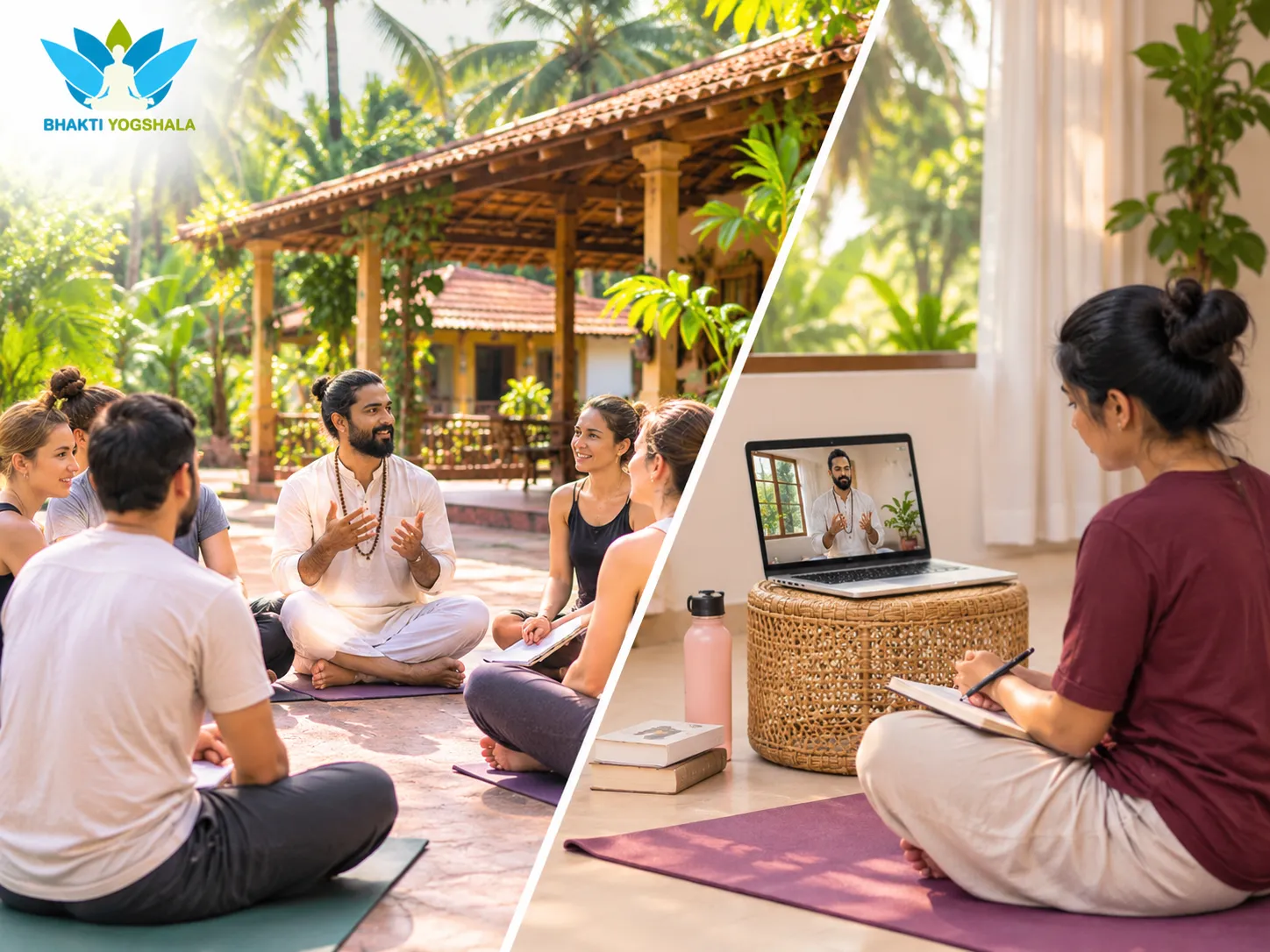
Choosing a yoga teacher training course involves more than comparing the syllabus or course fee. Where you stay during the programme can affect your daily routine, travel time, privacy, total expenses and opportunities to connect with other trainees.
A residential yoga teacher training programme generally arranges accommodation through the school or as part of the course package. A non-residential programme is also taught in person, but students arrange their own accommodation and travel to the training venue.
Neither format is automatically better. The right option depends on your budget, personal commitments, preferred living arrangements and the specific package offered by the school. If you are considering a 200-hour yoga teacher training course in Goa, this guide explains the main differences and what to check before booking.
Residential vs Non-Residential Yoga Teacher Training: The Quick Answer
Choose residential training if you prefer having accommodation organised alongside your course and want to stay close to the training environment. Consider non-residential training if you live nearby, want to select your own accommodation or need a particular living arrangement.
The key is to compare the full package—not only the tuition fee. Accommodation, meals, transport, course schedule and room arrangements can change the overall value of each option.
What Is Residential Yoga Teacher Training?
Residential yoga teacher training combines scheduled classes with accommodation arranged through the school or its programme. Students stay at the training location or in accommodation associated with the course for the stated period, following the course timetable rather than commuting from home or a separate hotel.
Staying close to the training venue may make it easier to attend early sessions, manage breaks and spend time with classmates outside formal lessons. These are possible benefits, not guarantees; the experience depends on the school’s schedule, accommodation setup and course policies.
What may be included in a residential programme?
Depending on the school and package, residential training may include:
Scheduled yoga practice and theory sessions.
Study of yoga philosophy, anatomy and teaching methodology.
Practical teaching exercises and supervised practice.
Accommodation for the stated course period.
Meals, where specified in the package.
Opportunities to practise or discuss lessons with other trainees.
These inclusions are not universal. Accommodation may be on-site or nearby, and room types, meals, facilities and extra charges vary. Review the written course details before assuming what is included.
What Is Non-Residential Yoga Teacher Training?
Non-residential yoga teacher training takes place in person, but students organise their own accommodation. Depending on their preferences and budget, they may stay in a guesthouse, hotel, rented room or another suitable property near the school.
This arrangement can offer greater choice over where you stay and may suit students who already live locally or have family responsibilities in the area. The trade-off is that you must plan your own travel to class, organise meals where needed and make sure your accommodation works with the daily timetable.
Non-residential does not mean online. Non-residential students still attend classes at the physical training venue; online learning is delivered remotely and has a different setup.
What should you plan for?
Distance between your accommodation and the training venue.
Daily transport and how reliable it is at class times.
Whether your accommodation is suitable for rest and independent study.
How meals and drinking water will be arranged.
Whether you can follow the full training timetable.
How much privacy and flexibility you want outside class hours.
A low room rate does not always mean a lower overall cost. Add transport, food, laundry and other daily expenses before comparing accommodation options.
Residential vs Non-Residential Yoga Teacher Training: Key Differences
| Factor | Residential training | Non-residential training |
|---|---|---|
| Accommodation | Arranged through the school or package, subject to stated terms. | Arranged independently by the student. |
| Daily routine | Staying at or near the venue may simplify the day. | Requires planning around travel and accommodation. |
| Travel to class | May be minimal if accommodation is on-site or nearby. | Depends on distance and transport options. |
| Meals | May be included in the package. | May need to be arranged and paid for separately. |
| Time with classmates | Living nearby may create more chances to connect outside class. | Interaction may mainly happen during training hours. |
| Privacy and room choice | Depends on the room options offered by the school. | Greater choice over independent accommodation. |
| Budget planning | One package may combine some major expenses. | Separate expenses need to be calculated. |
| Personal commitments | Requires planning for the residential period. | May be easier for local students or those with specific living needs. |
This table describes common differences rather than guaranteed features of every course. Confirm the actual arrangements for your chosen programme and batch.
How Accommodation Can Change Your Daily Routine
When you stay at or near the training location
If your accommodation is close to the classroom, you may spend less time commuting and find it easier to prepare for early sessions or return for breaks when the timetable allows. Living near classmates can also create informal opportunities to discuss lessons or practise together.
Informal practice is not a substitute for supervised teaching, instructor feedback or the formal learning activities included in the programme. Ask the school how teaching practice and assessment are organised.
When you arrange your own accommodation
Living independently lets you choose your surroundings, room type and daily arrangements. This may be preferable if you value privacy, already have a home nearby or want to select accommodation within a particular budget.
You will need to allow enough time for travel and make sure your arrangements support the course timetable. A property that looks convenient online may be less practical if transport is unreliable or the journey is longer than expected.
For either format, request the daily timetable before booking accommodation or making non-refundable travel plans.
How to Compare the Total Cost
The course fee alone does not tell you which format is more affordable. Compare the full cost of attending the programme, including the items below.
For a residential course, check whether the fee includes:
Training and study materials.
Accommodation and the number of nights covered.
Room occupancy and any private-room upgrade.
Meals and the days on which they are provided.
Any registration, transfer or additional charges.
For a non-residential course, add the cost of:
The course fee.
Accommodation for the entire training period.
Daily transport to and from class.
Meals and drinking water.
Laundry and everyday expenses.
Any deposits, cleaning fees or other accommodation charges.
Also check the payment schedule, deposit, cancellation policy and refund terms. Ask the school to confirm the total amount payable in writing. Do not assume residential training is always cheaper—or that independent accommodation is always more expensive. The outcome depends on the package, room type, course duration and personal spending.
Which Format May Suit You?
Residential training may suit you if:
You want to stay close to the training environment.
You can commit to the course dates and live away from home.
You prefer accommodation to be arranged as part of the course.
You want to reduce the time spent organising daily travel.
You value the possibility of connecting with classmates outside scheduled sessions.
Non-residential training may suit you if:
You already live within a convenient distance of the school.
You prefer to select your own accommodation.
You need a particular room arrangement or greater independence.
You can manage transport and meals around the timetable.
You have personal commitments that make a school-arranged stay less suitable.
These are starting points, not fixed rules. A residential course may still require independent travel arrangements, while a non-residential student living nearby may have a simple daily routine. Compare the schedule, accommodation, total cost and teaching structure together.
What to Check Before Enrolling
Accommodation: Is it included in the course fee, and where is it located?
Room options: Are shared and private rooms available? What additional charges apply?
Meals: Which meals are included, and on which days?
Schedule: What are the daily class times? Are there required activities outside class?
Curriculum: Which yoga styles and theory subjects are taught?
Practical teaching: How are teaching exercises, observation and feedback organised?
Total fee: What is included, what costs extra and what is the payment policy?
Course dates: Are dates and places confirmed for your intended batch?
Certification: What certificate is awarded, and what registration requirements apply to your intended teaching pathway?
Cancellation terms: What happens if your plans change?
Request current details in writing before paying a deposit or booking travel.
Residential 200-Hour Yoga Teacher Training at Bhakti Yogshala, Goa
Bhakti Yogshala offers a 200-hour yoga teacher training programme in Agonda, Goa. Its published course information describes a multi-style curriculum covering Hatha, Ashtanga Vinyasa, Vinyasa Flow and Yin Yoga, along with pranayama, meditation, yoga philosophy, anatomy and teaching methodology.
The published course page lists accommodation, vegetarian meals, Wi-Fi and weekend sightseeing trips among the programme inclusions. It also states that class sizes are limited to a maximum of 15 students. Confirm current arrangements, availability, inclusions and the terms for your selected batch directly with the school before enrolling.
Explore the course: 200-Hour Yoga Teacher Training in Goa — https://bhaktiyogshala.com/200-hour-yoga-teacher-training-goa/
Contact Bhakti Yogshala
Address: Main, Agonda Beach Road, Canacona, Agonda, Goa 403702
Phone / WhatsApp: +91 9897355995
Website: https://bhaktiyogshala.com/
Contact the school to confirm current dates, availability, accommodation options and course fees before making a decision.
Frequently Asked Questions
Is residential yoga teacher training better than non-residential training?
Neither format is automatically better. Residential training may simplify accommodation and travel planning, while non-residential training gives students more control over where they stay. Compare the course structure, practical learning opportunities and total cost before deciding.
Does non-residential yoga teacher training mean online learning?
No. Non-residential training generally means attending classes in person while arranging your own accommodation. Online training is delivered remotely and has a different learning setup.
Is accommodation included in Bhakti Yogshala’s 200-hour course in Goa?
Bhakti Yogshala’s published 200-hour course page lists accommodation among the programme inclusions. Confirm room options, the number of nights, current package price and any additional charges for your selected batch.
Are meals included in a residential yoga teacher training course?
It depends on the school and package. Bhakti Yogshala lists vegetarian meals among the inclusions on its published 200-hour Goa course page. Confirm the meal schedule and any exceptions directly with the school.
Is residential yoga teacher training more expensive?
Not necessarily. A residential package may combine training and accommodation, while non-residential students pay for these separately. Compare the full cost, including transport, meals, room arrangements and additional charges.
Can I choose my own accommodation during yoga teacher training?
That depends on the course terms. In a non-residential programme, students generally arrange their own accommodation. For a residential course, ask whether staying outside the school’s accommodation is permitted and whether this changes the fee.
What should I consider before booking accommodation in Goa?
Check the distance to the training venue, transport options, room arrangements, meal availability, cancellation terms and course timetable. Confirm training dates before making non-refundable bookings.
How do I choose the right 200-hour yoga teacher training course?
Review the curriculum, teaching practice, trainer support, schedule, accommodation, total cost and certificate details. Ask the school to clarify any point that could affect your learning experience or budget before enrolling.