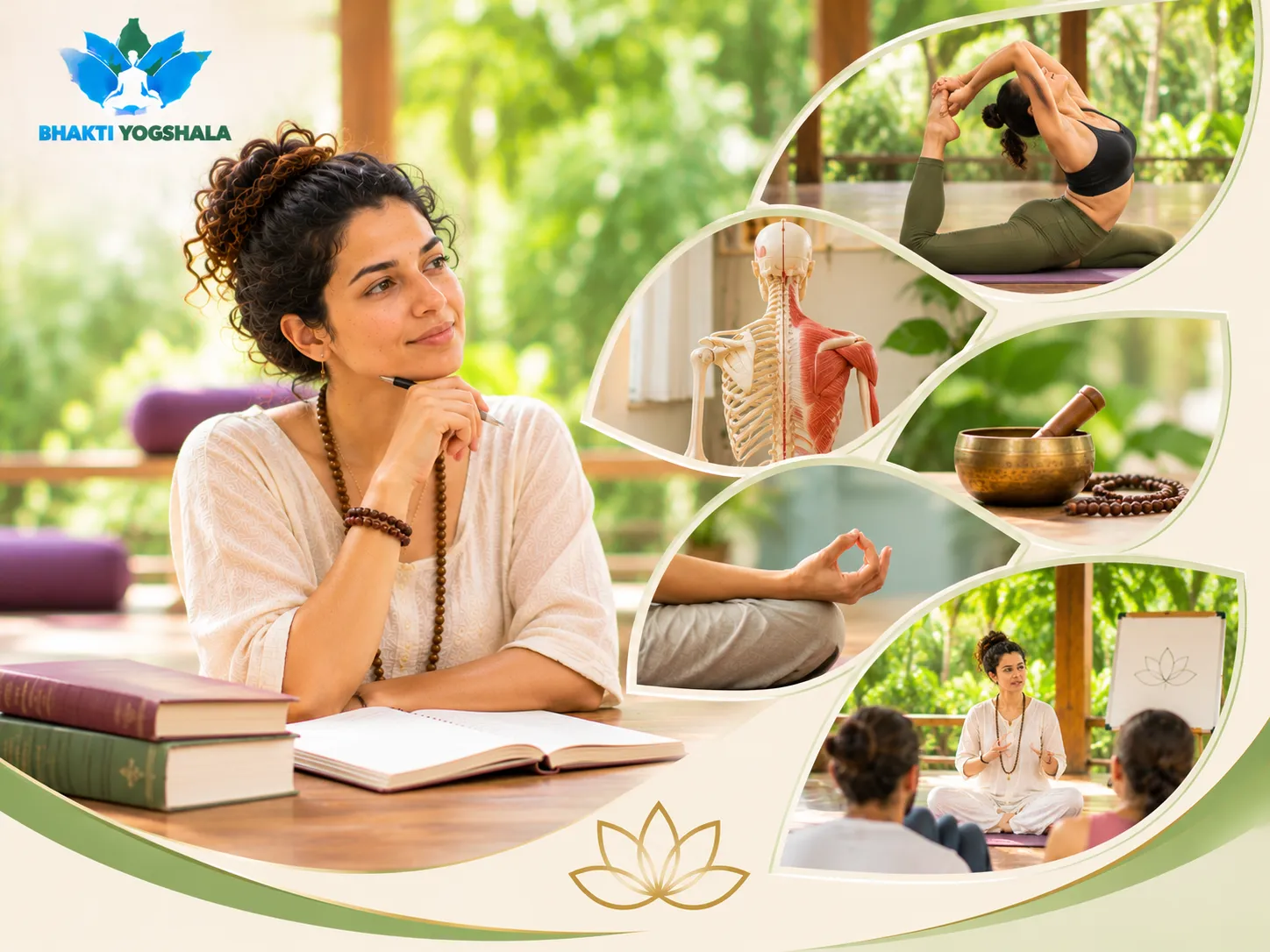

A yoga teacher who wants to study beyond foundational training has several directions to consider. Some want to refine their asana practice, understand yoga philosophy in greater depth and become more confident leading classes. Others are interested in adapting yoga practices to support people with specific health-related needs.
These goals overlap, but they are not the same.
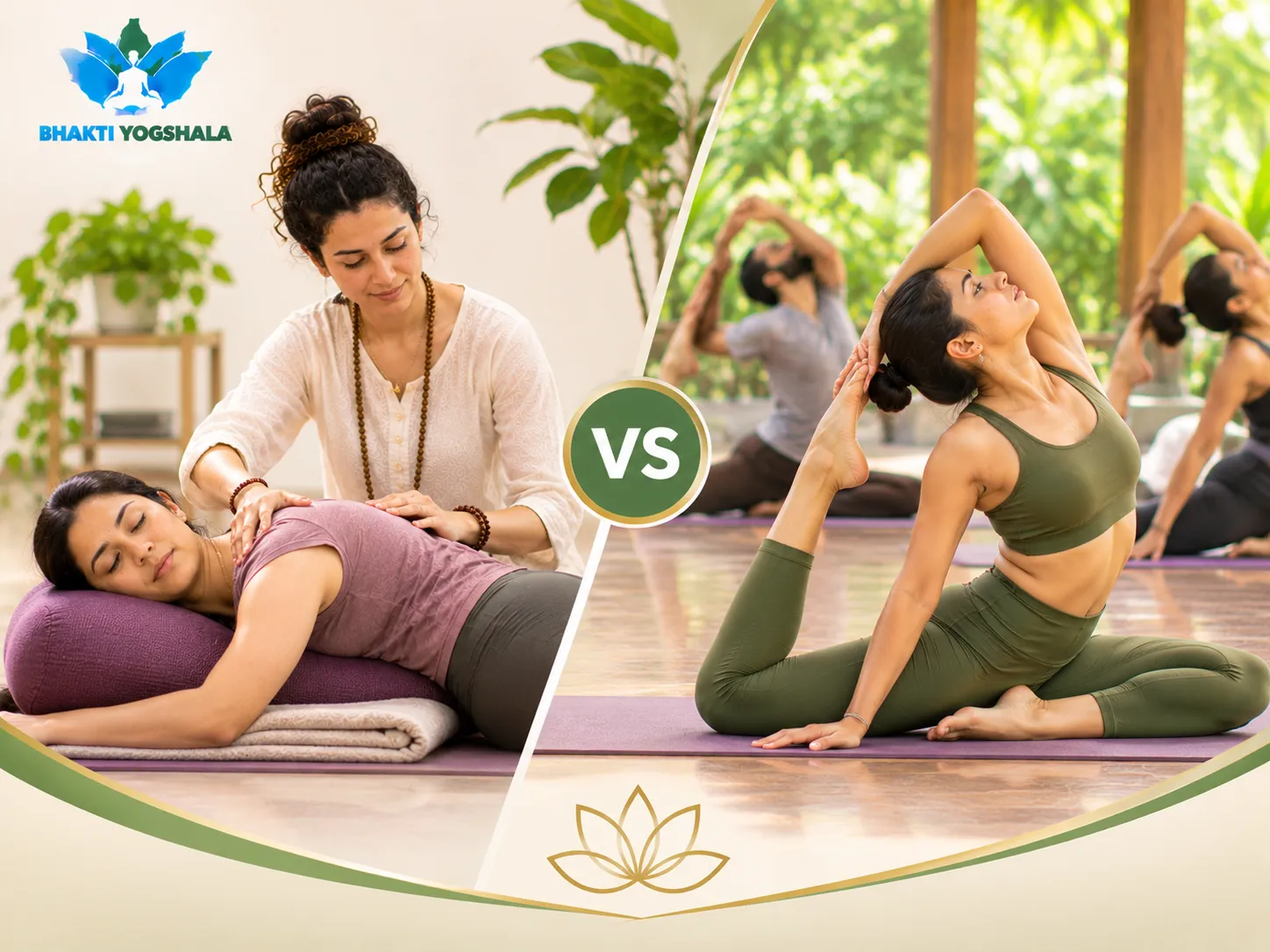
Therapeutic yoga education focuses on adapting yoga practices to an individual’s needs, while traditional advanced yoga teacher training generally develops a teacher’s broader knowledge of yoga, practice and teaching methodology. The right path depends on the work you want to do, the education you already have and the level of professional responsibility you intend to take on.
If you are researching a 300 hour yoga teacher training in Goa, it helps to understand this difference before selecting a programme.
Therapeutic yoga is an approach to applying yoga practices in response to individual needs and health-related goals. It may involve adapting postures, breathing practices, relaxation and other techniques based on a person’s circumstances.
Yoga therapy is a more specific professional field. The International Association of Yoga Therapists (IAYT) describes it as the professional application of yoga to promote health and well-being through a therapeutic relationship that includes individualised assessment, goal setting and personalised practices.
Traditional advanced yoga teacher training has a broader educational purpose. It builds on a teacher’s existing foundation through further study of asana, pranayama, meditation, anatomy, philosophy, sequencing and teaching skills.
The difference is not simply the subject being taught. It is the depth of preparation, the intended role of the graduate and the responsibility involved in working with individual clients.
Therapeutic yoga education explores how yoga practices can be adapted to suit an individual’s needs. Rather than teaching the same sequence to everyone, the practitioner considers the person’s circumstances, abilities, goals and relevant limitations.
Depending on the training programme, the subjects may include:
A therapeutic approach begins by understanding the person. This can involve discussing their needs, previous experience, movement limitations and goals. The practitioner uses this information to decide whether a proposed practice is appropriate.
A practice may need to be modified according to a person’s comfort, mobility, experience or other relevant factors. Adaptations can involve posture variations, props, breathing practices, relaxation and changes to the structure of a session.
Knowledge of anatomy helps practitioners understand movement and the physical demands of yoga practices. More specialised training may explore how to recognise limitations, consider contraindications and adapt instruction responsibly.
Therapeutic work requires careful communication. Practitioners should understand the limits of their training, avoid making medical diagnoses and know when a client should be referred to an appropriately qualified healthcare professional.
Theory alone is not enough preparation for individualised work. Ask whether the programme includes observed practice, mentorship, case-based learning, feedback and assessment.
IAYT’s published scope of practice describes yoga therapy as work grounded in education, experience and demonstrated competency. It also explains the importance of recognising when a matter falls outside a practitioner’s professional scope.
A traditional advanced yoga teacher training programme is generally designed for people who already have a foundation in yoga education and want to develop their practice and teaching skills further.
For example, Yoga Alliance describes an RYS 300 programme as advanced training that builds on the concepts generally taught at the RYS 200 level.
Its published educational categories include:
The emphasis can differ between schools. One programme may give greater attention to asana and alignment, while another may place more emphasis on philosophy, meditation or teaching methodology.
A good course description should make its curriculum and learning outcomes clear. Do not choose a programme based on the 300-hour label alone.
Comparison factor | Therapeutic yoga education | Traditional advanced yoga teacher training |
Main focus | Adapting yoga practices to individual needs | Developing broader yoga knowledge and teaching ability |
Learning approach | Assessment, individual goals and appropriate adaptations | Advanced practice, theory and teaching methodology |
Anatomy | Often applied to individual needs and practice considerations | Develops understanding of anatomy in relation to yoga |
Teaching environment | May involve one-to-one or small-group work | Often includes group classes and teaching practice |
Practical learning | May include supervised therapeutic practice and case-based learning | May include teaching demonstrations, observation and feedback |
Professional preparation | Requires specialised education and clear professional boundaries | Develops advanced yoga teaching knowledge and skills |
Suitable goal | Building a professional pathway in yoga therapy | Becoming a more knowledgeable and capable yoga teacher |
These are general distinctions, not a guarantee that every course follows the same structure. Review the actual curriculum, teaching hours and assessment methods before enrolling.
A 300-hour advanced yoga teacher training certificate should not automatically be treated as a professional yoga therapy qualification.
Yoga teacher training and yoga therapy education have different professional purposes. A teacher may learn how to offer suitable variations in a regular group class without having the specialised preparation needed to conduct individualised therapeutic work.
IAYT provides an established professional framework for yoga therapy education. It describes the C-IAYT credential and maintains standards for accredited yoga therapy training programmes. Its certification information includes an accredited training pathway of 800 hours or longer, alongside a separate portfolio review and evaluation route for eligible experienced practitioners.
If your goal is to become a professional yoga therapist, check:
Also check the scope of practice and ethical requirements. Yoga therapy should not be presented as a replacement for medical diagnosis or treatment.
Your choice should reflect the kind of teaching or professional work you want to pursue.
Before committing, check the programme’s accreditation, mentorship and eligibility requirements. A short workshop or a general 300-hour certificate should not be assumed to qualify you as a yoga therapist.
For many teachers, this is a sensible next step after foundational training. It can strengthen their teaching knowledge without implying that they have completed specialist clinical or therapeutic education.
Ask yourself what you want your working day to look like.
Do you see yourself leading regular group classes, developing advanced practice workshops or studying yoga philosophy in greater depth? A broad advanced teacher training course may be relevant.
Are you more interested in working with individuals who have specific health-related goals? You may need a dedicated yoga therapy education pathway with appropriate training, mentorship and professional standards.
You do not have to decide based on trends. Choose according to the work you are prepared to study for and practise responsibly.
Bhakti Yogshala lists a residential 300-hour yoga teacher training programme in Agonda, Goa. Its published course information describes a 28-day programme with subjects that include asana practice, pranayama, meditation, yoga philosophy, anatomy, alignment, adjustments and teaching methodology.
The course page also includes a section titled “Therapy”. It lists topics such as mudra therapy, water therapy, mud therapy and other alternative practices. The syllabus separately refers to yoga therapy and discusses health-related topics.
This is useful information for students interested in the subjects included in the school’s curriculum. However, the presence of therapy-related topics in a 300-hour teacher training syllabus does not establish that the programme is a dedicated yoga therapy qualification or an IAYT-accredited yoga therapy training programme.
If you want professional training specifically in yoga therapy, ask the school to clarify the course’s learning outcomes, the depth of its therapeutic curriculum, the qualifications of the relevant trainers and the professional credential, if any, that graduates can pursue.
If your goal is to deepen your general yoga practice and teaching knowledge, review the full residential 300-hour programme and check whether its subjects match your objectives.
Explore the programme: 300-Hour Yoga Teacher Training in Goa – Bhakti Yogshala
Before paying a deposit, request clear answers to these questions:
A clear course provider should be able to explain the programme without making promises that go beyond its actual training and credentials.
If your aim is to build on your existing yoga education, Bhakti Yogshala’s residential 300-hour programme in Agonda, Goa, is one option to explore.
Review the published curriculum and compare it with your learning goals. If you are specifically seeking a professional yoga therapy qualification, confirm whether the programme meets the requirements of the professional organisation relevant to that pathway. Do not assume that a general advanced teacher training certificate provides that qualification.
Bhakti Yogshala
For current course dates, fees, eligibility, accommodation and syllabus details, contact the school before booking.
View the 300-Hour Yoga Teacher Training Course
Therapeutic yoga education focuses on adapting practices to individual needs. Traditional advanced training develops broader knowledge of yoga, including asana, pranayama, philosophy, anatomy and teaching methodology.
Not automatically. A 300-hour advanced yoga teacher training certificate is not equivalent to a specialised yoga therapy qualification. Check the requirements of the professional organisation whose credential you intend to pursue.
Yes. Yoga therapy involves individualised assessment, goal setting and adapted practices within a professional therapeutic relationship. General yoga teaching usually focuses on guiding individuals or groups through yoga classes.
Many advanced programmes expect students to have completed foundational teacher training. Confirm the specific eligibility requirements with the school.
Its published 300-hour course syllabus includes therapy-related subjects. However, the website does not establish that this is a dedicated IAYT-accredited yoga therapy qualification. Contact the school for clarification.
The published syllabus includes asana, pranayama, meditation, yoga philosophy, anatomy, alignment, adjustments, teaching methodology and therapy-related topics. Request the current detailed curriculum before enrolling.
The course page lists a 28-day residential programme. Confirm current batch dates and duration directly with the school.
Review its accreditation, curriculum, trainer qualifications, supervised practice, assessment process, professional scope and the credential available after graduation.
Bhakti means “devotion, worship, attachment” in Sanskrit. In our Yogshala you will find teachers who are extremely devoted to their yoga practice and will fully support and guide you in yours. Are you ready to break your inner boundaries and let go of your self-limiting thoughts?


Copyright © 2024 bhakti Yogshala, All rights reserved.