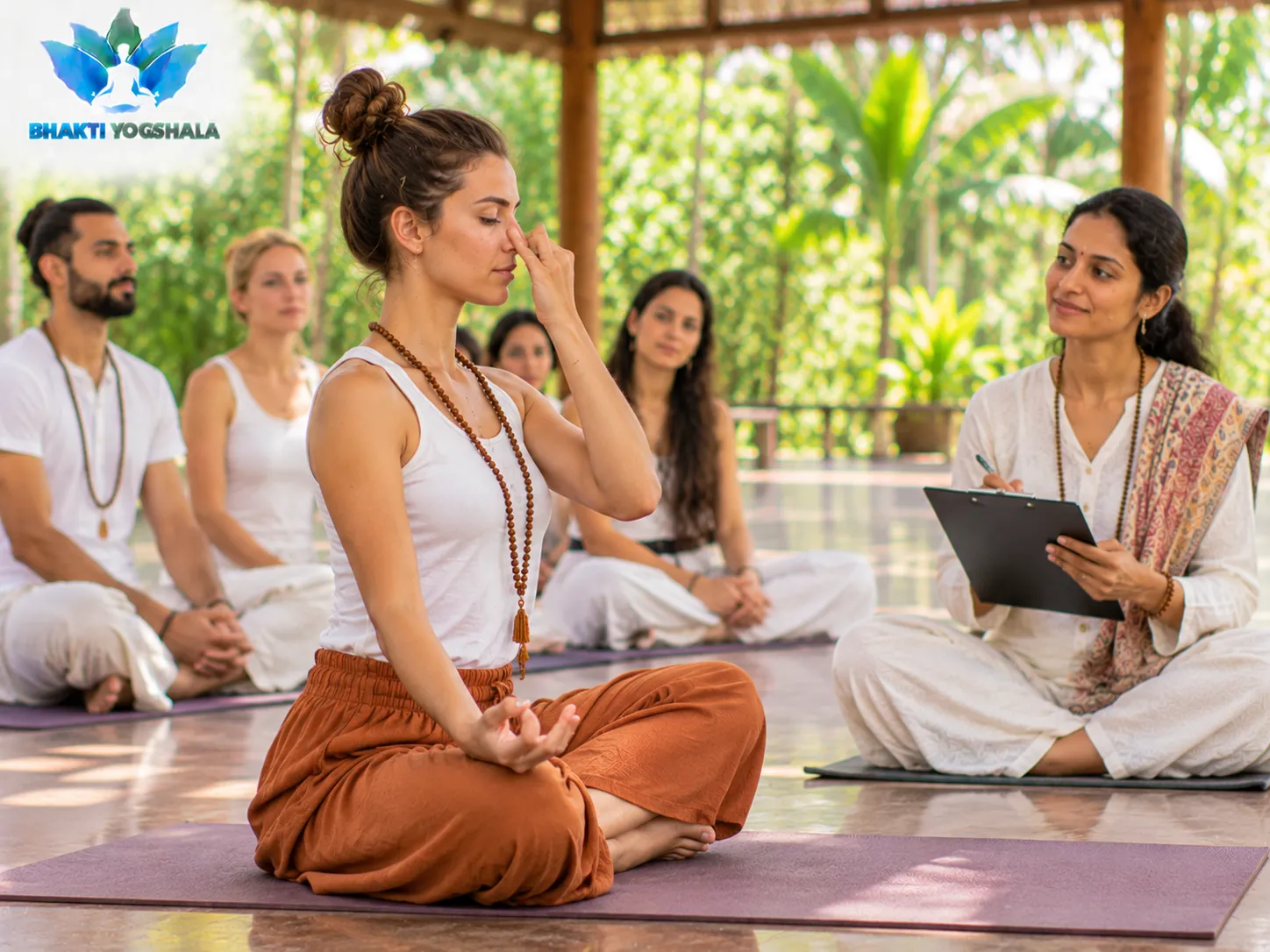
The final assessment is an important part of a 200-hour yoga teacher training course. It gives students an opportunity to demonstrate what they have learned during the programme, particularly their understanding of yoga practice and their ability to communicate instructions to others.
Depending on the school, the assessment may include a practical teaching demonstration, written or oral questions, lesson planning and a review of the subjects covered during training. The exact format, marking system and passing requirements are decided by the individual school.
For students attending a 200-hour yoga teacher training in Goa, understanding the assessment process before the course begins can make the final stage less stressful. It also helps you prepare for the skills that matter when guiding a yoga class.
At Bhakti Yogshala in Agonda, the published 200-hour curriculum includes teaching methodology, observation, demonstrations, adjustments, alignment and practicum classes. The school does not currently publish a detailed final examination format on its course page. Students should contact the school to confirm the assessment structure for their batch.
What Is the Final Assessment in a 200-Hour Yoga Teacher Training Course?
A final assessment is an evaluation conducted near the end of a teacher-training programme to check whether students have understood the material and can apply it in practice.
It may assess two broad areas:
- Knowledge: Understanding of asanas, pranayama, meditation, anatomy, yoga philosophy and teaching principles.
- Application: Ability to plan and guide a class, communicate instructions, observe students and make appropriate teaching decisions.
A student may understand the theory of a posture but still need practice explaining it to a group. The assessment helps the school evaluate how well the student can connect knowledge with teaching.
There is no single examination format used by every yoga school. Some programmes use written and practical tests, while others may include oral questions, lesson plans, assignments or continuous evaluation throughout the course.
Before enrolling, ask the school how it assesses students and what they must complete to receive the course certificate.
Why Do Yoga Schools Conduct a Final Assessment?
Completing the scheduled training hours is not the only consideration in a teacher-training programme. Students also need to demonstrate that they have understood and practised the subjects covered.
A final assessment gives the school an opportunity to review whether students can:
- Demonstrate the techniques taught during the programme.
- Explain basic yoga concepts accurately.
- Understand posture alignment and appropriate modifications.
- Plan a class with a clear sequence.
- Give instructions that students can follow.
- Recognise the importance of individual differences and safe practice.
- Understand the responsibilities and ethics of teaching yoga.
The assessment is also useful for students. It can show which skills have developed and which areas need more practice before they begin teaching independently.
What Are the Main Parts of a Yoga Teacher Training Final Assessment?
The assessment format varies between schools. The following are common examples of areas a 200-hour programme may evaluate. They should not be treated as a guaranteed examination structure for every institution.
1. Practical Teaching Demonstration
A practical assessment may ask you to lead a short yoga class or demonstrate how you would teach a particular sequence.
You may need to:
- Introduce the session and explain its purpose.
- Guide students through a warm-up.
- Demonstrate or explain selected asanas.
- Give clear verbal instructions.
- Coordinate movement with breathing.
- Guide transitions between postures.
- Offer appropriate variations.
- Bring the session to a suitable close.
The assessor may observe how you communicate, organise the class and respond to the needs of participants.
You are not necessarily expected to perform every advanced posture. Teaching involves helping other people understand and practise movements, not displaying your own flexibility.
2. Yoga Sequencing and Lesson Planning
A yoga teacher should understand how to arrange postures into a structured class.
An assessment may ask you to prepare a lesson plan or explain why you selected a particular sequence.
You may be evaluated on:
- The purpose of the session.
- The order of the selected postures.
- Warm-up and preparation.
- Transitions between movements.
- Appropriate pacing.
- Breathing instructions.
- Relaxation or closing practices.
For example, if you plan a beginner Hatha Yoga session, you should be able to explain why you selected the postures and how the sequence progresses.
A well-planned class should have a clear structure rather than a collection of unrelated asanas.
3. Asana Knowledge and Demonstration
Students may be asked to demonstrate or explain postures covered during their training.
This can involve:
- Starting position and alignment.
- Main actions involved in the posture.
- Breathing coordination.
- Common alignment mistakes.
- Appropriate modifications.
- Situations in which a student may need an alternative.
For example, when explaining Trikonasana (Triangle Pose), you should understand the basic positioning of the feet, legs, torso and arms. You should also be able to communicate the instructions clearly rather than relying only on a physical demonstration.
4. Anatomy and Alignment Questions
Anatomy helps yoga teachers understand how the body moves during practice.
Depending on the school’s assessment method, students may be asked about subjects such as:
- Major muscle groups involved in common asanas.
- Basic skeletal structure and joint movement.
- Flexion, extension and rotation.
- Breathing mechanics.
- Balance and stability.
- Alignment principles.
- Movement limitations and modifications.
You do not need to approach these questions as a medical professional. The aim is to understand the anatomical concepts taught during training and use them responsibly when guiding yoga practice.
5. Pranayama and Meditation
A 200-hour course may also assess your understanding of breathing practices and meditation.
Questions or demonstrations may cover techniques included in the school’s syllabus, such as Nadi Shodhana, Bhramari or other pranayama methods.
You may be asked to explain:
- The basic steps of a technique.
- How to guide the practice.
- The importance of a comfortable position.
- How to give clear instructions.
- When a participant may need to stop or modify a practice.
For meditation, the assessment may involve explaining a method, guiding a short practice or describing the principles covered during training.
6. Yoga Philosophy and Teaching Ethics
Yoga teacher training includes subjects beyond physical postures. Depending on the programme, the theoretical assessment may cover yoga history, philosophical concepts, the Yoga Sutras, the eight limbs of yoga and the responsibilities of a teacher.
You should be prepared to explain the concepts taught during your course in your own words.
Questions may also address teaching ethics, respectful communication, student boundaries and the importance of creating an inclusive learning environment.
What Is Evaluated During the Practical Teaching Exam?
A practical teaching assessment looks at how you apply your learning in front of a group.
The following table shows examples of areas an assessor may review. The exact grading criteria depend on the school.
Assessment area | What may be observed |
Preparation | Whether the class has a clear purpose and suitable structure |
Sequencing | Whether the selected postures follow a logical order |
Verbal instruction | Whether directions are clear and understandable |
Demonstration | Whether the teacher can demonstrate or explain the movements |
Breathing | Whether breathing instructions are appropriate and well-timed |
Alignment | Whether important alignment principles are communicated |
Modifications | Whether suitable alternatives are offered when needed |
Class management | Whether the teacher manages time and group participation |
Communication | Whether the teacher speaks clearly and respectfully |
Closing | Whether the session ends in an appropriate way |
Do not assume that every school uses this exact checklist or assigns equal marks to each area. Ask for the assessment rubric if the school has one.
How Does Yoga Alliance Approach 200-Hour Competency Assessment?
Yoga Alliance’s Registered Yoga School 200 standards describe four educational categories:
- Techniques, Training and Practice: Asana, pranayama, meditation and related practices.
- Anatomy and Physiology: Understanding the body and its relationship to yoga practice.
- Yoga Humanities: Yoga history, philosophy, ethics and related subjects.
- Professional Essentials: Teaching methodology, professional development and practicum.
Under its published RYS 200 standards, schools are expected to assess students’ knowledge, skills and experience before issuing a 200-hour certificate. Students should demonstrate proficiency rather than receive a certificate solely because they attended the scheduled training.
The standards require schools to explain how they assess competency. They do not prescribe one universal final examination paper, identical practical test or common pass mark for every school.
You can read the official requirements in the Yoga Alliance Standards for Registered Yoga Schools.
When comparing a 200-hour yoga teacher training in Goa, ask the school how its assessment process relates to the relevant registration standards and what students must complete before graduation.
What Happens If You Find the Assessment Difficult?
Feeling nervous before a practical teaching demonstration or written test is understandable, particularly if you have not taught a group before.
If you struggle with a particular subject, speak to your instructor rather than waiting until the final day.
Depending on the school’s policy, possible support may include:
- Additional practice sessions.
- Individual feedback from an instructor.
- Revision of theoretical subjects.
- Another opportunity to demonstrate a skill.
- Guidance on improving lesson planning or verbal instructions.
These are possible forms of support, not guaranteed options. Ask the school about its actual reassessment, resubmission and retake policies before the course begins.
A difficult assessment does not automatically mean you are unsuited to teaching yoga. It may show that you need more practice in a particular area.
How to Prepare for Your Final Yoga Teacher Training Assessment
Preparation is easier when you work on small parts of the syllabus throughout the course instead of trying to revise everything at the end.
Practise Teaching Regularly
Use the teaching-practice opportunities provided during the course. Practise giving instructions to classmates and ask for feedback.
Pay attention to whether people can understand your directions without needing repeated explanations.
Revise Your Asana Knowledge
Review the postures covered in class. Practise explaining the starting position, alignment, breathing and suitable modifications.
Try describing a posture without demonstrating it. This helps you check whether you understand the instructions well enough to communicate them.
Review Anatomy and Philosophy Notes
Keep your notes organised by subject. Revise important anatomical terms, movement principles, philosophical concepts and teaching ethics.
Focus on understanding rather than memorising isolated definitions.
Practise Sequencing
Prepare short class plans using the methods taught by your instructors.
Check whether each sequence has a clear beginning, main practice and closing section. Make sure the transitions and pacing are appropriate for the intended class.
Ask for Feedback Before the Assessment
Ask your instructors which skills need improvement. If you receive feedback about unclear instructions, sequencing or timing, practise those areas before the final evaluation.
Understand the Assessment Rules
Confirm the format, duration, pass criteria, attendance requirements and reassessment policy with your school.
Knowing what is expected will help you plan your preparation.
What Should You Confirm Before Joining Bhakti Yogshala?
Bhakti Yogshala’s published 200-hour course page lists a multi-style curriculum that includes Hatha, Ashtanga Vinyasa, Vinyasa Flow and Yin Yoga. It also describes pranayama, meditation, yoga philosophy, anatomy and teaching methodology.
The teaching methodology section includes:
- Lifestyle and ethics of a yoga teacher.
- Classroom management.
- Principles of observation.
- Demonstrations.
- Assisting and hands-on adjustment techniques.
- Correct alignment and potential risks of yoga postures.
- Practicum classes.
Its typical daily schedule also includes an asana clinic, adjustment and practicum session.
These published details show that practical teaching and teaching methodology form part of the programme. However, the public course page does not explain the exact final assessment format.
Before enrolling, ask Bhakti Yogshala:
- Is there a written examination, oral examination or practical teaching test?
- Will students need to teach a complete class?
- How long is the practical assessment?
- Which subjects are included in the theory assessment?
- Is there a published assessment rubric or pass mark?
- What attendance and coursework requirements must be completed?
- Can students receive feedback or additional support if they need improvement?
- Is there a reassessment or retake process?
- What are the requirements for receiving the final course certificate?
Get the answers for your selected batch in writing. Assessment arrangements can vary between programmes and may change over time.
Begin Your 200-Hour Yoga Teacher Training in Goa
The final assessment gives students an opportunity to demonstrate their understanding of yoga and their readiness to apply the skills developed during training. Regular practice, clear communication and a sound understanding of the course subjects can help you approach it with greater confidence.
Bhakti Yogshala offers a multi-style 200-hour yoga teacher training programme in Agonda, Goa. Its published syllabus includes asana practice, pranayama, meditation, yoga philosophy, anatomy, teaching methodology and practicum.
If you are considering joining, review the 200-hour Yoga Teacher Training in Goa programme and contact the school to confirm the current batch dates, faculty, assessment format, course inclusions and certification requirements.
Bhakti Yogshala
Main Agonda Beach Road, Agonda, Goa – 403702
Phone: +91 9897355995
Email: bhaktiyogshala@gmail.com
FAQS
- What happens during the final assessment of a 200-hour yoga teacher training course?
The assessment may include a practical teaching demonstration, written or oral questions, lesson planning and evaluation of subjects covered during the course. The exact format depends on the school.
- Is there a practical exam in a 200-hour yoga teacher training course?
Some schools include a practical teaching assessment in which students demonstrate their ability to guide a yoga class. Ask your school whether this is part of its final examination.
- What subjects are covered in a yoga teacher training final exam?
Possible subjects include asana, pranayama, meditation, anatomy, yoga philosophy, teaching methodology, sequencing and teaching ethics.
- Is the final assessment difficult?
The difficulty depends on the course curriculum and assessment requirements. Regular practice, revision and feedback from instructors can help students prepare.
- What happens if I fail the final yoga teacher training assessment?
Policies differ between schools. Ask whether additional practice, reassessment or a retake is available, and whether extra fees or deadlines apply.
- Does Yoga Alliance require a final examination for RYS 200 courses?
Yoga Alliance requires schools to assess students’ knowledge, skills and experience before issuing a 200-hour certificate. Its standards do not prescribe one identical examination format for every school.
yogaalliance.org+1
- Does Bhakti Yogshala include practical teaching in its 200-hour course?
Bhakti Yogshala’s published syllabus lists teaching methodology, observation, demonstrations, adjustments and practicum classes. Its public course page does not specify the exact final assessment format. Contact the school for the current batch’s examination details.
Bhakti Yogshala
- How can I prepare for the final yoga teacher training assessment?
Practise teaching regularly, revise asanas and anatomy, review yoga philosophy, prepare lesson sequences and ask instructors for feedback. Confirm the school’s assessment criteria before the final evaluation.