Choosing between a 100-hour, 200-hour and 300-hour yoga teacher training can be confusing because the numbers describe the training hours, but they also represent different stages of yoga education.
The simplest way to think about them is:
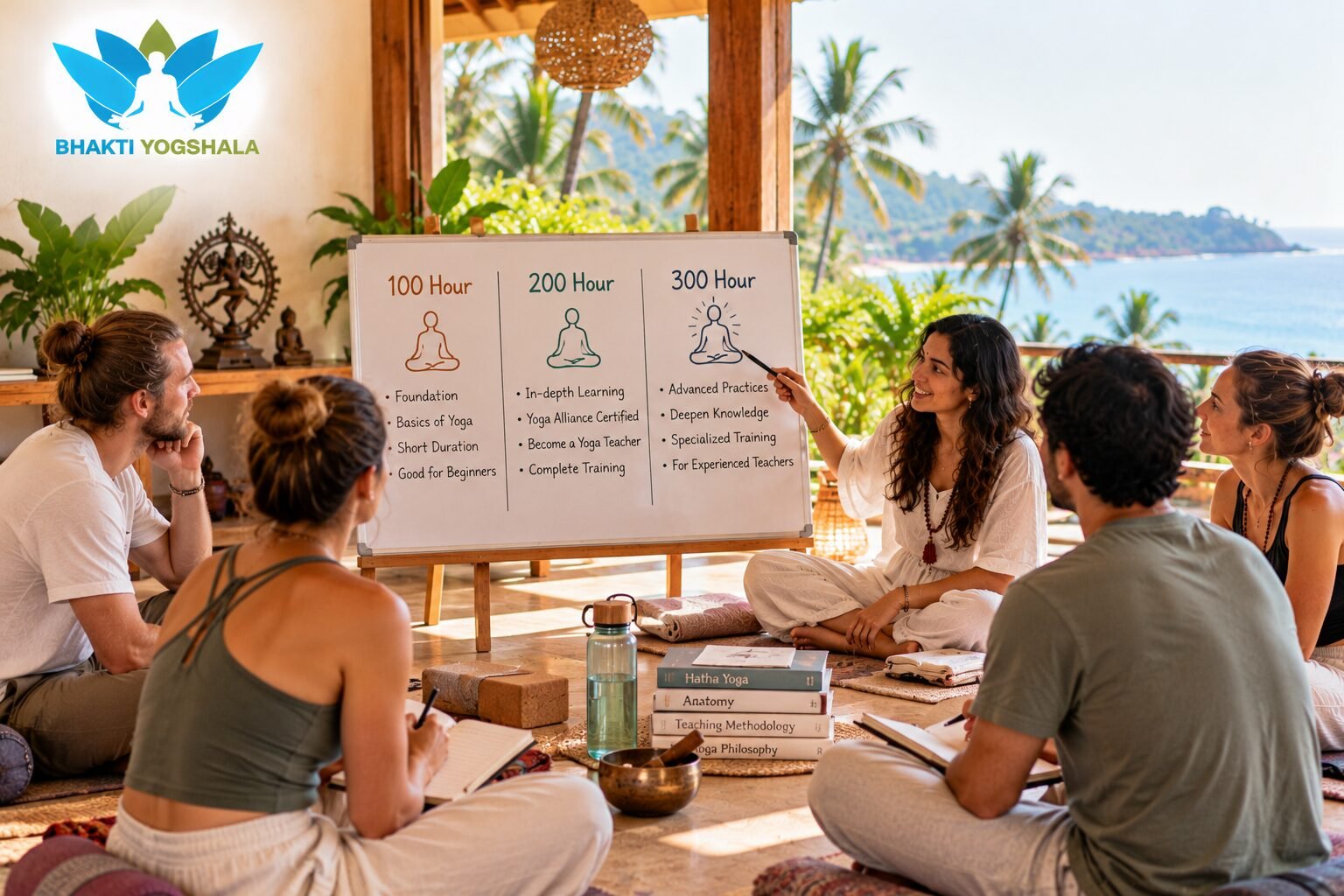
- 100 hours: a shorter introduction or focused foundation for people who want a more limited training commitment.
- 200 hours: the foundational level for people seeking a complete yoga teacher training and the RYT 200 pathway through a qualifying Yoga Alliance Registered Yoga School.
- 300 hours: an advanced level designed to build on foundational yoga teacher education.
Bhakti Yogshala offers 100-hour, 200-hour and 300-hour multi-style yoga teacher training programs, with training options in Goa and Rishikesh. Its website also lists online 200-hour training.
The right choice depends less on choosing the largest number and more on where you are in your yoga journey, what you want to learn and what you want to do after training.
The Difference Between 100, 200 and 300 Hour Yoga Teacher Training
The main difference is the depth, stage and purpose of the training.
A 100-hour course provides a shorter learning format. A 200-hour program is generally the foundational teacher-training level. A 300-hour program is advanced education that builds on previous teacher-training knowledge.
Yoga Alliance describes an RYS 200 program as foundational teacher training, while an RYS 300 program is designed to deepen and build upon the fundamental concepts generally taught at the 200-hour level.
That means the three levels should not simply be viewed as three versions of the same course with different lengths.
Quick comparison
Training | Typical purpose | Best suited to |
100 Hour | Shorter foundational learning | People seeking a shorter training experience or introduction |
200 Hour | Foundational teacher training | Beginners and practitioners seeking a complete foundational training |
300 Hour | Advanced training | Practitioners who already have foundational teacher training |
The exact curriculum, duration, prerequisites and credentialing arrangements vary by school, so always check the individual program before enrolling.
What Is a 100-Hour Yoga Teacher Training?
A 100-hour yoga teacher training is a shorter training format compared with a full 200-hour program.
It can make sense for someone who has limited time, wants to explore yoga education more deeply, or is not ready to commit to a longer teacher-training program.
Bhakti Yogshala currently lists a 100-hour yoga teacher training in Goa and a 100-hour yoga teacher training in Rishikesh.
Who might consider a 100-hour course?
A 100-hour program may be worth considering if you:
- Have limited time available for training
- Want to deepen your personal yoga practice
- Want an introduction to structured yoga education
- Want to understand whether a longer teacher-training format suits you
- Prefer a shorter intensive learning experience
However, 100 hours should not automatically be treated as equivalent to a 200-hour foundational teacher-training credential.
If your goal is specifically to pursue the Yoga Alliance RYT 200 credential, Yoga Alliance states that this requires completion of a 200-hour training with an RYS 200.
Before enrolling in a 100-hour program, check exactly what certificate it provides and how the hours can or cannot be used toward future training.
What Is a 200-Hour Yoga Teacher Training?
A 200-hour yoga teacher training is generally the foundational level for people who want structured teacher education.
Yoga Alliance states that teachers can obtain the RYT 200 credential after completing a 200-hour yoga teacher training registered with Yoga Alliance. The current standards also state that multiple trainings cannot be combined to meet the 200-hour requirement for RYT 200.
Bhakti Yogshala describes its 200-hour training as a comprehensive program for beginners and intermediate practitioners. Its curriculum includes areas such as asana, pranayama, meditation and philosophy, while its multi-style training introduces styles including Hatha, Vinyasa and Ashtanga.
Who should consider a 200-hour yoga teacher training?
A 200-hour course can be a strong starting point if you:
- Are new to formal yoga teacher training
- Want comprehensive foundational education
- Want to develop your personal practice while studying yoga more deeply
- Are considering teaching yoga professionally
- Want to pursue the RYT 200 pathway through an eligible RYS 200 program
You do not necessarily need to be an experienced yoga teacher before beginning foundational training. The individual school’s admission requirements should always be checked before enrolling.
What can a 200-hour course cover?
Depending on the school and curriculum, foundational teacher training can include areas such as:
- Asana practice
- Pranayama
- Meditation
- Yoga philosophy
- Anatomy and physiology
- Teaching methodology
- Practicum
- Professional development
Yoga Alliance’s current RYS standards establish educational requirements for registered school programs, although individual schools may structure and emphasize their curriculum differently.
What Is a 300-Hour Yoga Teacher Training?
A 300-hour yoga teacher training is an advanced level of education.
Rather than being simply a longer beginner course, an RYS 300 program is intended to build upon and deepen foundational yoga teaching knowledge. Yoga Alliance describes the 300-hour level as advanced training that develops more advanced, detailed or subtle understanding and teaching skills.
Bhakti Yogshala describes its 300-hour programs in Goa and Rishikesh as advanced training for experienced practitioners, with an emphasis on advanced yoga styles, teaching methodologies and spiritual practices.
Who should consider a 300-hour course?
A 300-hour program is generally more appropriate if you:
- Already have foundational yoga teacher training
- Want to deepen your teaching knowledge
- Want to study more advanced aspects of yoga
- Want to refine your teaching methodology
- Are looking for continued professional development
Before enrolling, check the school’s specific prerequisites. A 300-hour program is not automatically interchangeable with a 200-hour foundational program.
100 vs 200 vs 300 Hour Yoga Teacher Training: Comparison
Factor | 100 Hour | 200 Hour | 300 Hour |
Level | Shorter/focused | Foundational | Advanced |
Training commitment | Lower | Higher | Higher and more advanced |
Typical learner | Practitioner seeking shorter study | Beginner or practitioner seeking foundational teacher training | Existing teacher/practitioner with foundational training |
Main objective | Explore or deepen practice | Build foundational teaching knowledge | Deepen and refine existing knowledge |
RYT 200 pathway | Not by itself | Yes, when completed through an eligible RYS 200 | Not by itself |
RYT 500 pathway | Not by itself | Can form the foundational part of a 200 + 300 pathway | Can form the advanced part of a 200 + 300 pathway |
Recommended starting point for a first full teacher training | Depends on your goal | Generally the more relevant level | Usually not the starting point |
The table describes the general distinction. Individual schools may structure their courses differently, so the course curriculum and credential status should always be checked.
How Yoga Alliance Credentials Relate to 200 and 300 Hours
This is an important distinction because the terms 200 hour, 300 hour, RYS 200, RYS 300, RYT 200 and RYT 500 are sometimes used interchangeably when they are not the same thing.
Yoga Alliance identifies:
- RYS 200: a Registered Yoga School credential for a foundational 200-hour training.
- RYS 300: a Registered Yoga School credential for an advanced 300-hour training.
- RYT 200: an individual teacher credential that can be obtained after completing a qualifying 200-hour training with an RYS 200.
- RYT 500: an individual credential requiring 500 hours of qualifying training, either through an RYS 500 program or a qualifying combination of 200-hour and 300-hour training.
There is another important requirement: Yoga Alliance’s current RYT 500 standards state that applicants must also complete at least 100 teaching hours after completing an RYS 200 or RYS 500 training.
So it is more accurate to say that a qualifying 200-hour + 300-hour pathway can form the training component for RYT 500, rather than saying that completing a 300-hour course automatically makes someone an RYT 500.
Which Yoga Teacher Training Should You Choose?
Your decision should start with your goal.
Choose a 100-hour course if:
You want a shorter, focused training experience and do not necessarily need the full foundational 200-hour pathway immediately.
It may also suit you if you want to explore structured yoga education before making a larger time commitment.
Choose a 200-hour course if:
You are beginning your formal teacher-training journey and want a comprehensive foundation.
This is generally the level to investigate if your goal includes pursuing the RYT 200 credential through a qualifying Yoga Alliance Registered Yoga School.
Choose a 300-hour course if:
You already have foundational yoga teacher training and want to advance your knowledge and teaching skills.
A 300-hour program is better viewed as advanced education, rather than a substitute for foundational training.
A simple decision rule
Ask yourself three questions:
- Is this my first formal yoga teacher training?
If yes, investigate the 200-hour level first.
- Do I already have a qualifying 200-hour training?
If yes, a 300-hour advanced program may be the more relevant next step.
- Do I have limited time and mainly want to deepen my yoga study?
A 100-hour format may be worth considering, depending on the curriculum and certificate provided.
100, 200 and 300 Hour Training at Bhakti Yogshala
Bhakti Yogshala currently presents 100-hour, 200-hour and 300-hour yoga teacher training options across its training locations.
Its website lists:
- 100-hour training in Goa
- 100-hour training in Rishikesh
- 200-hour training in Goa
- 200-hour training in Rishikesh
- 200-hour Kundalini training in Goa
- 200-hour training in Kerala
- Online 200-hour training
- 300-hour training in Goa
- 300-hour training in Rishikesh
The school describes its approach as multi-style and identifies Hatha, Vinyasa and Ashtanga among the styles included in its 200-hour training.
The website also states that its training incorporates areas including yoga asana, pranayama, mantra chanting, meditation, philosophy and yoga anatomy.
Because course schedules, admission requirements and certification arrangements can change, prospective students should confirm the current details for the specific program they are considering.
Goa or Rishikesh: Where Should You Train?
Once you have selected the appropriate training level, the next question may be location.
Bhakti Yogshala offers training in both Goa and Rishikesh, and its website describes the Goa experience as being near Agonda Beach while positioning Rishikesh as a traditional yoga destination.
The choice can therefore come down to the environment in which you want to spend your training period.
Goa
Goa may appeal if you prefer:
- A coastal environment
- South Goa and the Agonda area
- A beach-adjacent setting
- A relaxed destination alongside your training
Rishikesh
Rishikesh may appeal if you prefer:
- A Himalayan setting
- A destination strongly associated with yoga
- A more traditional yoga-centred environment
- The cultural atmosphere of Rishikesh
Bhakti Yogshala’s current location comparison notes that both Goa and Rishikesh offer 100-, 200- and 300-hour options.
Questions to Ask Before Enrolling in a Yoga Teacher Training
Before paying a deposit or booking travel, ask the school:
- What level is this course designed for?
- Is previous teacher training required?
- What certificate will I receive?
- Is the school currently registered for the relevant Yoga Alliance designation?
- What is included in the curriculum?
- How much teaching practice is included?
- How are anatomy and yoga philosophy taught?
- How long does the training take?
- Is accommodation included?
- Are meals included?
- What are the current fees?
- What are the cancellation and refund policies?
- Is the training residential or non-residential?
- Which location is the program held in?
- If I complete a 300-hour course, what prerequisite documentation is required?
These questions help you compare schools based on the actual training rather than simply the number of hours.
Find the Right Yoga Teacher Training for Your Stage
There is no universal rule that the highest number of training hours is automatically the best choice.
A 100-hour program may make sense for a shorter learning commitment. A 200-hour program is the key foundational level to investigate when beginning formal teacher training. A 300-hour program is designed for deeper, advanced study after foundational training.
The best choice depends on your current experience, your learning goals, the credential you are pursuing, the curriculum, the school’s registration status and the amount of time you can realistically commit.
Bhakti Yogshala offers multiple training levels and locations, including Goa and Rishikesh, allowing students to compare programs according to their goals and preferred learning environment.
If you are unsure which course fits your background, review the specific program requirements or contact Bhakti Yogshala before enrolling.
FAQS
1. Is 100 hours enough to become a yoga teacher?
It depends on the specific program and what certificate it provides. A 100-hour course should not automatically be treated as equivalent to a qualifying 200-hour foundational teacher training. For the Yoga Alliance RYT 200 credential, Yoga Alliance requires completion of a 200-hour training with an RYS 200. Yoga Alliance
2. Is 200-hour yoga teacher training suitable for beginners?
Yes. Bhakti Yogshala describes its 200-hour training as suitable for beginners and intermediate practitioners. Relaxa
3. What is the difference between 200 and 300 hour yoga teacher training?
A 200-hour program provides foundational teacher education, while a 300-hour program is advanced training intended to build upon foundational knowledge. Yoga Alliance
4. Can I take a 300-hour yoga teacher training without completing 200 hours?
The prerequisite depends on the school and program. You should confirm the admission requirements before enrolling. A 300-hour RYS program is designed as advanced training building upon foundational knowledge. Yoga Alliance
5. Do 200 and 300 hours equal 500 hours?
For Yoga Alliance’s RYT 500 training requirement, a qualifying 200-hour training plus an additional qualifying 300-hour advanced training can satisfy the 500 training-hour requirement. Additional teaching requirements also apply. Yoga Alliance
6. Which yoga teacher training is best for a beginner?
For someone beginning formal teacher training, a 200-hour foundational course is generally the most relevant level to investigate. The specific school’s admission requirements and curriculum should still be reviewed.
7. Does Bhakti Yogshala offer all three training levels?
Yes. Bhakti Yogshala’s current website lists 100-hour, 200-hour and 300-hour teacher training options, including programs in Goa and Rishikesh. Relaxa
8. Does Bhakti Yogshala offer yoga teacher training in Goa?
Yes. The website currently lists 100-hour, 200-hour and 300-hour training options in Goa. Relaxa
9. Does Bhakti Yogshala offer yoga teacher training in Rishikesh?
Yes. The website currently lists 100-hour, 200-hour and 300-hour training options in Rishikesh. Relaxa
10. Where is Bhakti Yogshala located?
Bhakti Yogshala lists its main address as Main Agonda Beach Road, Agonda, Goa 403702, with the phone number +91 9897355995 on its website. Relaxa