Choosing a yoga teacher training course is not simply about finding the course with the most hours or the most attractive location. The right program depends on why you want to study yoga, what you want to learn, how you prefer to learn and what you hope to do after completing the course.
Someone preparing for a career as a yoga teacher may need a different training pathway from someone who wants to deepen their personal practice. Similarly, a student interested in traditional yoga may have different priorities from someone looking for a particular style such as Hatha, Ashtanga, Vinyasa or Kundalini.
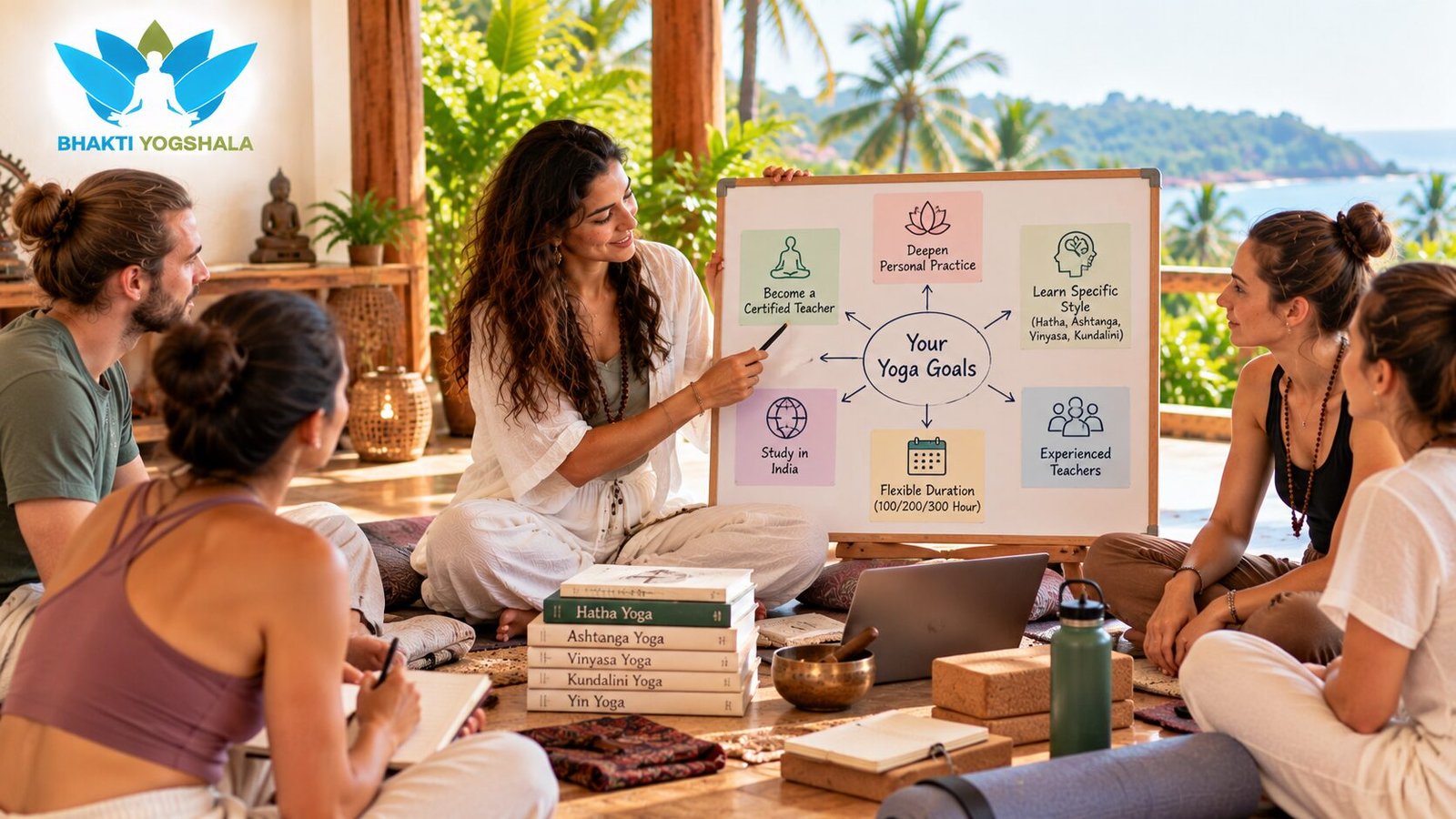
Before enrolling, start with your goal. Then compare the course structure, curriculum, teachers, format, certification and location against that goal.
Start With Your Reason for Doing Yoga Teacher Training
Your reason for joining a yoga teacher training course should be the first thing you consider.
Ask yourself:
- Do I want to become a professional yoga teacher?
- Do I want to deepen my personal yoga practice?
- Do I want to understand yoga philosophy and meditation more deeply?
- Do I want to study a particular yoga style?
- Do I want an immersive residential experience?
- Do I need the flexibility of online learning?
- Am I looking for an introduction to teaching or more advanced study?
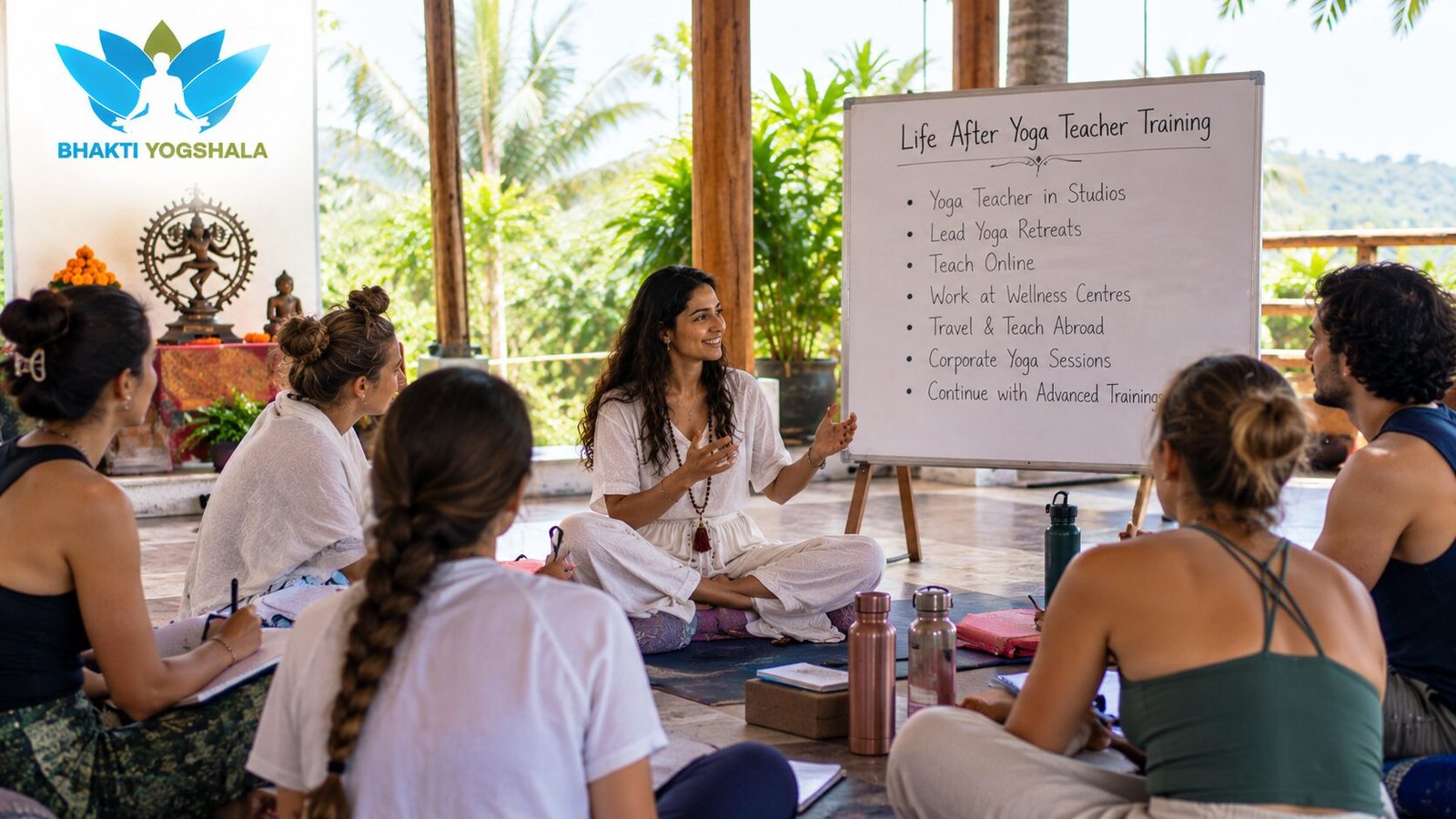
If Your Goal Is to Become a Yoga Teacher
If teaching is your main goal, look beyond the name of the course.
Review whether the curriculum includes areas that help you develop teaching-related skills, such as yoga practice, teaching methodology, sequencing, communication and other subjects included in the school’s stated curriculum.
You should also check the certification provided by the school and understand what the certification represents before enrolling.
If Your Goal Is Personal Development
You do not necessarily need to choose a program solely because it is designed around becoming a professional teacher.
A teacher training course can also be a structured way to deepen your understanding of yoga practice, philosophy, meditation, pranayama and related subjects.
In this situation, consider whether the course content matches the areas you genuinely want to explore.
If You Want to Deepen a Specific Yoga Practice
If you already know which style interests you, compare programs based on the amount and depth of relevant training.
For example, someone interested in Kundalini may want a course specifically focused on Kundalini rather than choosing a general multi-style program simply because it is longer.
The same principle applies when comparing Hatha, Ashtanga, Vinyasa or other approaches.
Choose the Course Duration That Matches Your Goals
Yoga teacher training courses are available in different formats and durations.
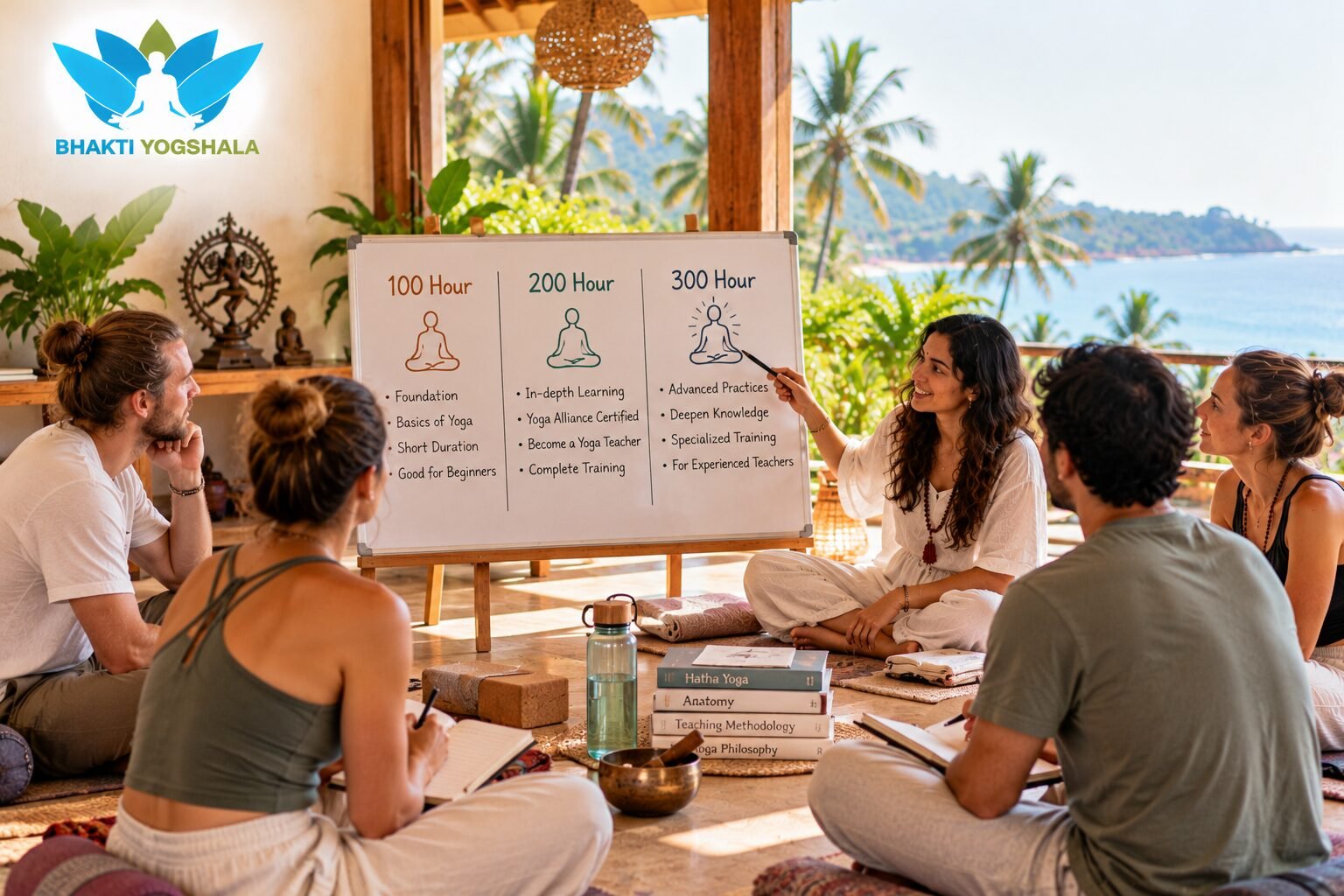
Bhakti Yogshala currently lists 100-hour, 200-hour and 300-hour teacher training programs, including programs in Goa, Rishikesh and Kerala, as well as online training options.
The important question is not simply, “Which course has more hours?”
Instead ask:
What level of study matches what I am trying to achieve?
A shorter program may suit someone looking for an introduction or focused training, while a longer program may provide more time for structured study and practice.
For example:
Your goal | What to consider |
Explore yoga more deeply | Introductory or shorter training |
Build a stronger foundation | A structured foundational YTT |
Prepare for teaching | A comprehensive teacher-training program |
Continue after foundational training | Advanced or higher-hour training |
Study from home | Online teacher training |
The exact suitability depends on the curriculum and your previous experience, so compare what each course actually teaches rather than choosing based only on the number of hours.
Think About the Yoga Style You Want to Study
Yoga teacher training is not one single learning experience.
Different programs may place different emphasis on practices such as Hatha, Ashtanga, Vinyasa, Kundalini, meditation, pranayama and yoga philosophy.
Before choosing a course, ask:
Which practices do I want to spend time learning?
If you want exposure to several approaches, a multi-style course may be worth considering.
If you already have a strong interest in one style, a more specialized program may be a better match.
The goal is not to find the style that sounds most impressive. It is to find the style and teaching approach that fit your interests and future plans.
Compare the Curriculum, Not Just the Course Title
Two courses can have similar names but very different learning experiences.
Read the curriculum carefully.
Look for information about:
- Asana practice
- Pranayama
- Meditation
- Yoga philosophy
- Anatomy
- Teaching methodology
- Sequencing
- Practicum or teaching practice
- Lifestyle and yogic traditions
- Any specialized subjects relevant to your goals
Bhakti Yogshala’s current blog content also describes areas such as yoga philosophy, anatomy and meditation within its discussion of 200-hour YTT.
A useful comparison question is:
“What will I actually spend my time learning and practicing?”
This is more useful than judging a course by its title alone.
Decide Between Residential and Online Training
Your preferred learning environment can make a major difference.
Residential Yoga Teacher Training
Residential training can provide an immersive environment where your daily routine is centered around yoga study and practice.
This may appeal to students who want to step away from their usual routine and dedicate a defined period to learning.
Bhakti Yogshala lists residential-style teacher training options in locations including Goa, Rishikesh and Kerala.
Online Yoga Teacher Training
Online training can be useful for students who need greater flexibility or cannot travel to a physical school.
Bhakti Yogshala also lists online yoga instructor and 200-hour online teacher training options.
When comparing online courses, check how the teaching is delivered, how much interaction is included and whether the format suits the way you learn.
The right format is the one that allows you to participate consistently and engage meaningfully with the course.
Check the Certification and Recognition
Certification is an important part of comparing yoga teacher training courses, particularly if you intend to teach after completing your training.
Do not simply assume that every certificate has the same meaning.
Before enrolling, check:
- Who issues the certificate?
- What does the certification represent?
- Is the school associated with a recognized yoga organization?
- Does the course meet any specific requirements relevant to your future plans?
- Are the certification details clearly explained by the school?
Bhakti Yogshala’s website lists Yoga Alliance-oriented teacher training and certification options among its programs.
If certification is important to your career plans, verify the current details directly with the school before enrolling.
Consider the Teachers and Teaching Approach
A curriculum tells you what is taught. The teachers influence how you experience that learning.
Before choosing a course, explore the school’s information about its teachers and teaching approach.
Consider:
- Their areas of teaching
- The subjects they teach
- Their approach to students
- Whether the teaching style suits you
- How much practical learning is included
You are not only choosing a course. You are choosing the people and environment through which you will learn.
Choose a Location That Supports Your Learning Goals
Location can influence your overall training experience.
Bhakti Yogshala currently presents teacher training options associated with Goa, Rishikesh and Kerala, while its website also lists Nepal among its locations.
Think about what you want from the location.
Goa
Goa may appeal to students who want a coastal setting and a residential learning environment.
Rishikesh
Rishikesh may appeal to students who want to study yoga in a destination strongly associated with India’s yoga tradition.
Kerala
Kerala can appeal to students interested in combining yoga study with the broader wellness traditions associated with the region.
Nepal
Nepal may appeal to students looking for a different cultural and geographical environment for their yoga journey.
The best destination is ultimately the one that fits your practical requirements and learning preferences.
Look Beyond the Price
Course price is naturally important, but it should not be the only deciding factor.
When comparing programs, understand what is included and what is not.
Depending on the program, this may involve considerations such as:
- Course tuition
- Accommodation
- Meals
- Course materials
- Certification
- Additional activities
- Travel
- Personal expenses
A lower advertised price does not necessarily mean lower total spending, and a higher price does not automatically mean a better educational experience.
Compare programs on overall value and suitability, not price alone.
A Simple Checklist for Choosing Your Yoga Teacher Training Course
Before making your decision, ask these questions:
- What is my main goal?
Teaching, personal development, deeper practice, specialization or simply exploring yoga?
- What level of training do I need?
Consider whether a shorter, foundational or advanced program better matches your current experience and objectives.
- Which yoga styles interest me?
Look at the actual curriculum rather than relying only on the course title.
- What will I learn?
Compare the curriculum, practical training and teaching-related subjects.
- Do I prefer residential or online learning?
Choose the format that fits your schedule, learning style and circumstances.
- What certification will I receive?
Understand the certification before enrolling, especially if you plan to teach professionally.
- Who will teach me?
Review the school’s teacher information and teaching approach.
- Where do I want to study?
Consider location, travel requirements, environment and the kind of experience you want.
- What is included in the course?
Check accommodation, meals, materials and other inclusions before comparing prices.
- Does the course actually match my goals?
This is the most important question of all.
A course can be highly rated, popular or located in a famous yoga destination, but if its curriculum does not match your goals, it may not be the right choice for you.
Explore Yoga Teacher Training Options at Bhakti Yogshala
Bhakti Yogshala offers teacher training options across different durations, locations and learning formats. Its current program listings include 100-hour and 200-hour training in Goa and Rishikesh, 200-hour training in Kerala, 300-hour training in Goa and Rishikesh, Kundalini training in Goa, and online teacher training options.
If you are comparing programs, start by identifying your goal and then review the course that most closely matches it.
For students considering an in-person experience, Bhakti Yogshala’s listed address is Main Agonda Beach Road, Agonda, Goa 403702.
The right yoga teacher training course is not necessarily the longest, cheapest or closest option. It is the one whose curriculum, teaching approach, format, certification and learning environment align with what you want to achieve.
Before enrolling, take time to compare the details and contact the school if you need clarification about the current course structure, availability or certification.
FAQs
1. How do I choose the right yoga teacher training course?
Start by identifying your main goal. Then compare the course duration, curriculum, yoga styles, certification, teaching approach, format and location against that goal.
2. Which yoga teacher training course is best for beginners?
There is no single course that is best for everyone. Beginners should look for a program whose curriculum, pace and prerequisites match their current experience and learning goals.
3. Should I choose a 100-hour, 200-hour or 300-hour yoga teacher training course?
The appropriate duration depends on your experience and objective. Compare the curriculum and level of training rather than choosing only based on the number of hours.
4. Is residential yoga teacher training better than online training?
Neither format is automatically better. Residential training can provide an immersive environment, while online training can provide greater flexibility. Your circumstances and preferred learning style should guide the decision.
5. What should I look for in a yoga teacher training curriculum?
Review the subjects included in the program, such as asana, pranayama, meditation, philosophy, anatomy and teaching methodology, and check whether they support your specific goals.
6. Does yoga teacher training require previous teaching experience?
Requirements vary between programs. Check the specific eligibility criteria of the course you are considering rather than assuming that previous teaching experience is required.
7. How important is certification when choosing a yoga teacher training course?
Certification can be particularly important if you intend to teach professionally. Check who issues the certificate and what recognition or requirements apply to your intended teaching pathway.
8. Can I choose a yoga teacher training course based on a specific yoga style?
Yes. If you have a strong interest in a particular style, compare specialized programs with multi-style programs and review the actual curriculum before deciding.
9. What should I consider besides the course fee?
Consider the curriculum, teaching approach, course duration, certification, accommodation, meals, materials, travel and other expenses that may affect the overall cost.
10. How do I know whether a yoga teacher training course matches my goals?
Write down what you want to achieve first. Then compare your goals against the course’s curriculum, duration, teaching format, certification and learning environment.